Most of us daydream about the one big signal, the afternoon that changes everything. For Peter Hughes it did not happen like that. His find came slowly, over 21 years of walking the same stretch of Welsh sand and letting the storms do the hard work for him.
Now a good part of what he recovered is on public display for the first time. A free exhibition called Tides of Treasure opened at the National Waterfront Museum in Swansea on 26 June 2026, and it tells the story of a shipwreck that has been quietly giving up its secrets on Margam Beach for the best part of half a millennium.
A ship that never made it home
The finds are believed to come from the Ann Francis, the newest and biggest ship belonging to a King’s Lynn merchant named Francis Shaxton. On the evening of 28 December 1583 she ran aground on Margam Beach, over on the Glamorgan coast near modern Port Talbot, caught out on the return leg of a trading voyage.
She had carried a cargo of grain to Spain and Portugal, and was coming home with the payment for it. That payment is the interesting bit. A lot of the money aboard was in older coin that was, by 1583, effectively out of date. It was being carried as silver bullion, the kind of thing that would normally be taken to the Mint in London and turned into fresh English coin. The ship lost her way, went onto the beach, and the silver never made it to London.
What happened next is a very human story. The wreck was promptly plundered by local people, until agents of the local landowners turned up, restored order, and then laid claim to the goods themselves. Shaxton eventually learned of his ship’s fate and, after long legal battles, recovered some of his property, including anchors, cannon, cables and money. Plenty was left behind in the sand though, and that is what has been turning up ever since.
What has come out of the sand
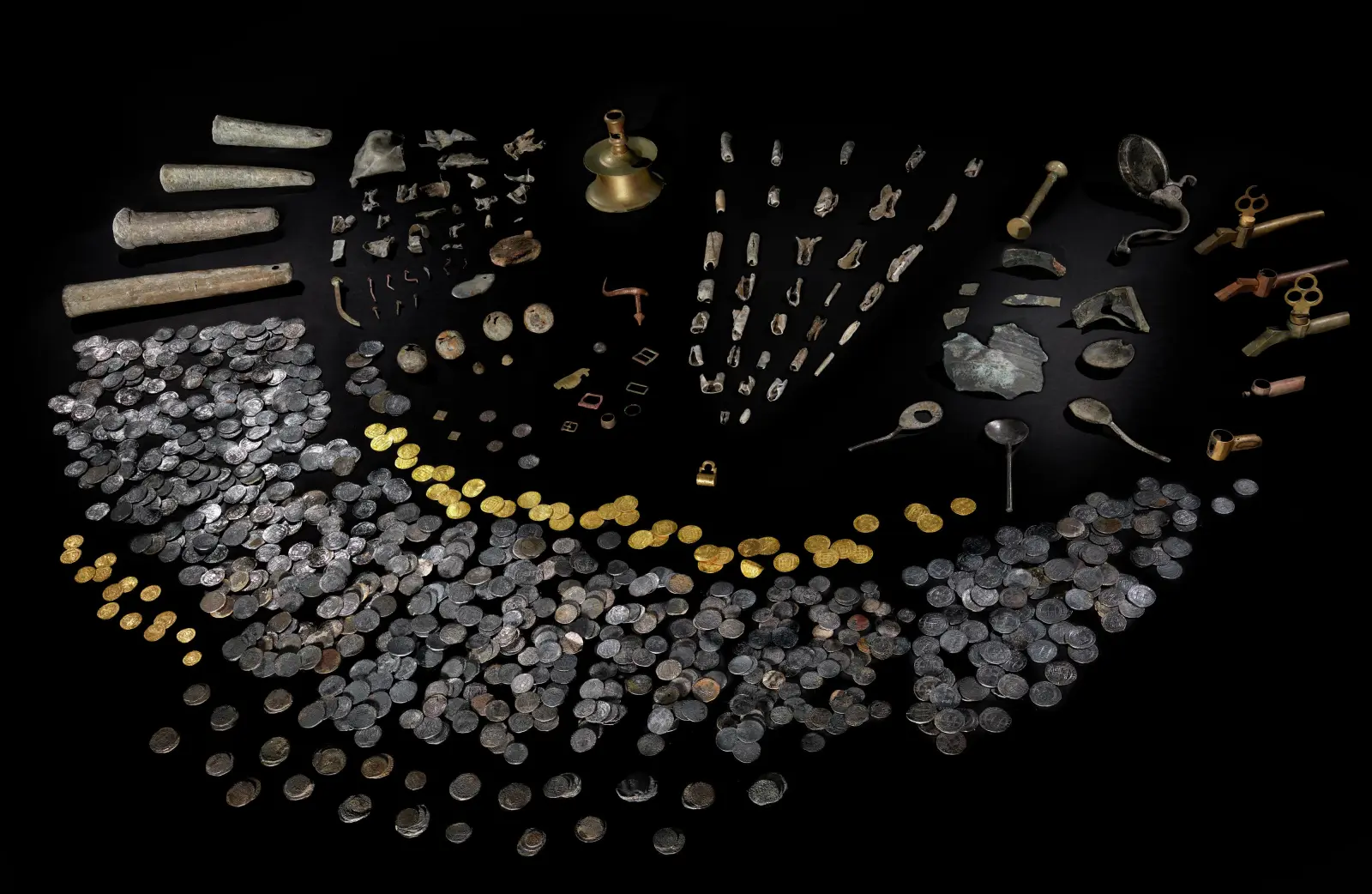
For years, coins and objects have been found on Margam Beach. Most are fairly recent, but there is a clear cluster of mid-16th-century material that points straight at a Tudor wreck. The coins are mostly silver: pieces of Ferdinand and Isabella of Spain, and talers from the German states of the Holy Roman Empire. There are a few copper coins of John III of Portugal, and even two rather special gold coins, one Spanish and one Portuguese, including a gold San Vicente showing the saint holding a martyr’s palm and a little model ship.
Alongside the money came the working life of the ship: navigational dividers, lead sounding weights, and a bosun’s call, the whistle an officer used to give orders on deck. On display too is an ornate combination lock from one of the ship’s wooden chests. By all accounts only around a quarter of the money thought to have been aboard has been recovered so far, which tells you the beach is not finished with us yet.
Hughes, now 69, first struck lucky back in 1996 and kept at it for 21 years as storms stripped the sand away and exposed more. He has described lifting that first coin as just incredible, and said he felt overwhelmed to see the collection finally out on show. Anyone who has stood on a cold beach at first light, waiting to see what the last tide uncovered, will know exactly the feeling he means.
Why this one matters to us
This is a lovely reminder of what beach detecting actually is. It is not a quick hobby. The sea moves tonnes of sand around with every big blow, and a spot that gives up nothing for months can suddenly open up after one rough week in winter. Patience, local knowledge and going back again and again are worth more than any fancy machine. If you are just getting into it, our guides section is a good place to start, and it is worth knowing exactly where you can legally metal detect, beaches included, before you head out.
It is also a model of doing things properly. Finds like these are recorded and handled through the Portable Antiquities Scheme in Wales, and items that qualify go through the treasure process before a museum can acquire and display them. That chain, from finder to finds liaison officer to museum case, is exactly what turns a pocketful of green coins into a story the whole country can share. Report your finds, log them, and let the experts add the history. A single coin on its own is a curiosity. A recorded collection like this one is a window straight back to a December storm in 1583.
If you are anywhere near Swansea this summer, Tides of Treasure is free to visit and well worth an hour of your time.
Sources
Reported by Nation.Cymru and Yahoo News / PA, with historical background from Amgueddfa Cymru, National Museum Wales.
Detectorist World summary; see the linked reports for the original coverage and photos.