Imagine finding a Roman silver coin, then another, and another, only to discover that you’ve stumbled upon something much bigger.
That’s what happened to detectorist Oliver Riedl during a permitted search near Wesseling, Germany, in October 2025.
The discovery was announced by German archaeological authorities on 22 September 2026, and it’s quite a find.
From 15 Coins to 934
After recovering 15 silver coins, Oliver was still getting signals. Rather than continuing to recover them himself, he contacted the LVR archaeological authorities.
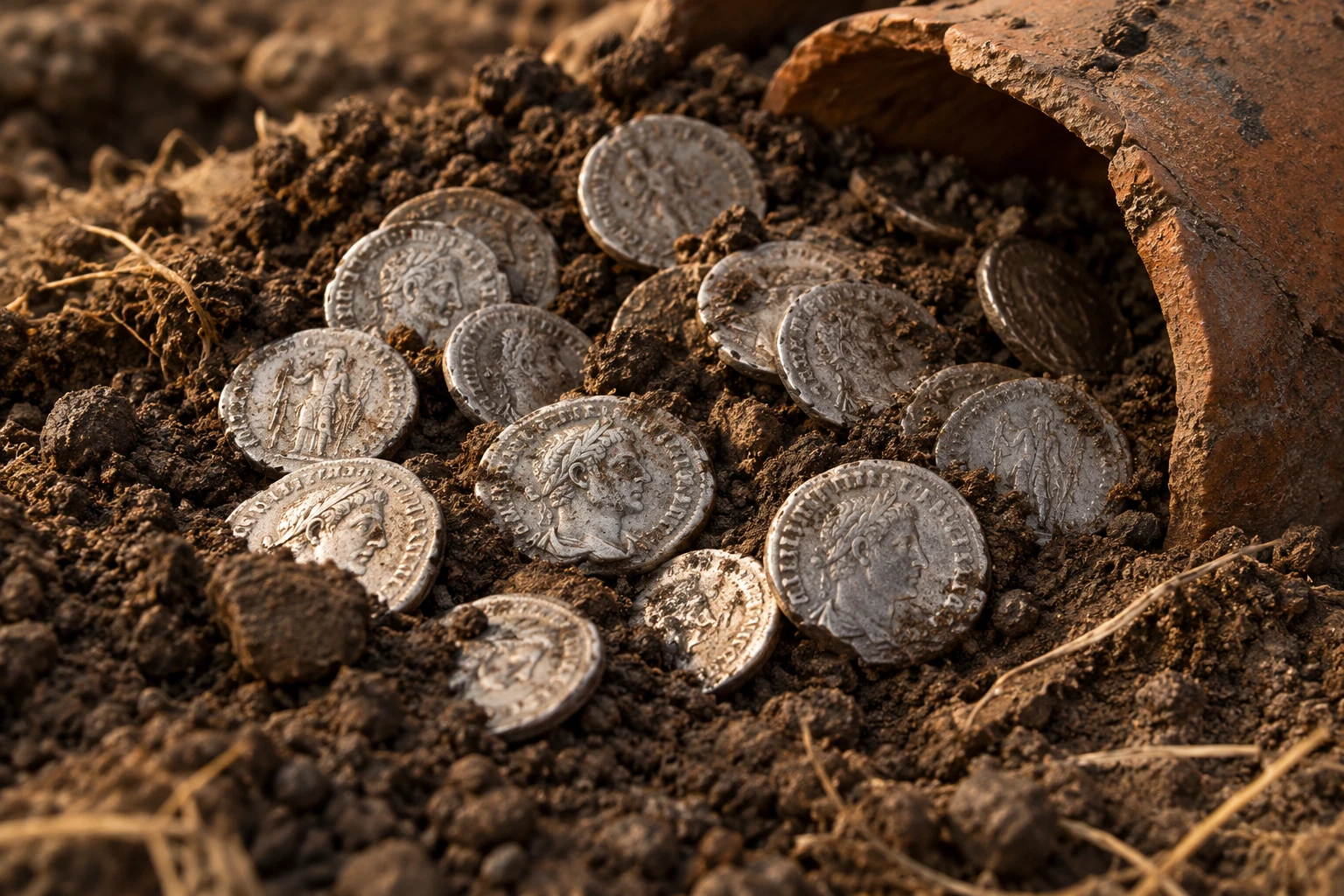
Archaeologists subsequently recovered 934 Roman silver denarii, weighing approximately 3.1 kilograms altogether.
The oldest coin dates back to 148 BC, while the newest was minted around AD 124/125, during the reign of Emperor Hadrian.
According to the LVR, it’s the largest coin hoard from Hadrian’s time discovered in Germany.
Specialists also examined a carefully lifted block of soil using X-rays. Pottery fragments and traces of straw suggest the coins may originally have been buried inside a straw-lined pot.
Who buried them, and why they never returned, remains a mystery.
A Reminder of Why Context Matters
For anyone interested in metal detecting, there’s something particularly interesting about how this discovery unfolded.
The coins themselves are remarkable, but so is the information preserved by bringing archaeologists into the picture.
It’s easy to concentrate on the object coming out of the ground. Yet sometimes the surrounding soil, fragments and positioning can tell us just as much about its history.
Here in England and Wales, our guide to Finds Liaison Officers explains how finds can be recorded through the Portable Antiquities Scheme. That’s a separate system from the German authorities involved in this discovery.
And perhaps that’s the real attraction of this hobby. You never quite know what piece of history might be waiting beneath your feet.