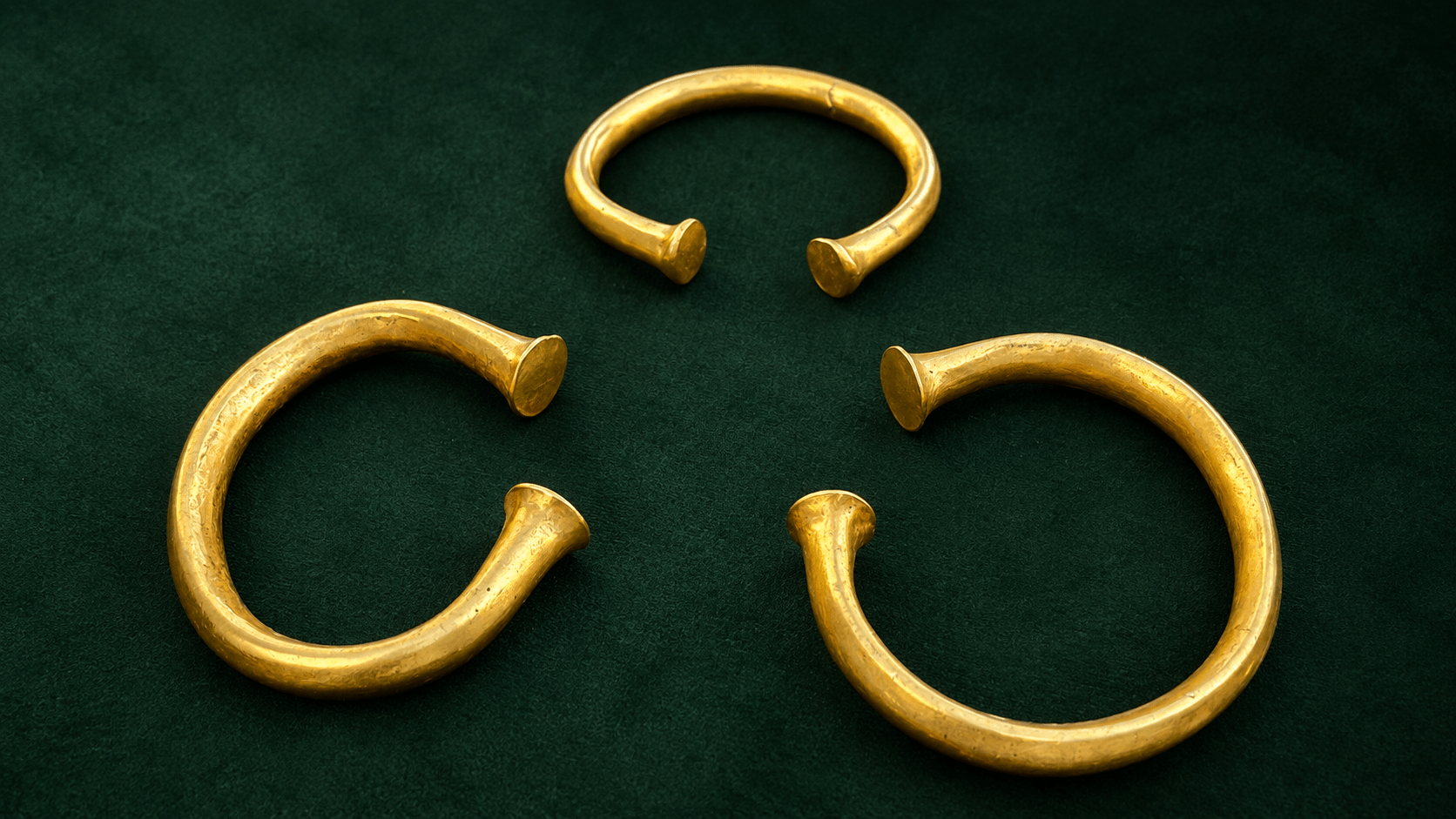
Every detectorist knows the feeling of packing up at the end of a long day with nothing but ring pulls and a sore back to show for it. Andy Crammond and Alan Daniels knew it better than most. The two Scottish mates had been detecting together for years and, by their own admission, always came home disappointed. Then, on a field near Carlisle, one signal changed everything. Andy dug up what he first took for a bull’s nose ring, and within minutes the pair had pulled three Bronze Age gold torcs from the same patch of ground. Rally organisers have since called it “the find of 100 lifetimes”, and for once the hype might be justified.
What they found, and where
The find happened on Saturday 23 May at a rally near Harker, just outside Carlisle, organised by Lothian Relics Metal Detecting. Andy, a 34-year-old gas engineer, picked up the first torc a few inches down and clocked almost straight away that it was “too shiny to be a bull ring”. He carried it over to Alan, 48, in a bit of a daze. In Alan’s telling, Andy reckoned he was about to have a heart attack. Rather than crack on, they decided to double-check the exact spot, and about three feet away sat a second torc. A quick sweep roughly ten metres out turned up a third.
The torcs date to around 1100 BC, which puts them near the tail end of the Middle Bronze Age, and they weigh in at roughly 18 ounces of at least 22-carat gold between them. As Alan put it, “gold doesn’t tarnish at all, and they came out of the ground just the same as when they went in, over 3,000 years ago.” Anyone who has rinsed the soil off a gold find and watched it gleam like it was lost yesterday will know exactly what he means.
Why three complete torcs is such a big deal
Torcs were worn round the neck or wrist in the Bronze Age, and the honest answer to what they meant is that we are not entirely sure. Archaeologists debate whether they were status symbols for the well-to-do or communal objects tied to certain roles and rituals. Many that survive show signs of heavy wear and repair, which hints they were kept and passed down rather than simply buried and forgotten.
What makes this find stand out is that all three are complete. Dr Jim Morris, an archaeologist at the University of Lancashire, called them “spectacular”, pointing out that survivors usually turn up as fragments. In his words, “to find a complete one is rare, and three complete ones is even rarer.” Cumbria has only ever produced one other torc before this, and that was a single. Three together, found clean and close, is the sort of thing that gets specialists reaching for words like nationally significant. Morris also flagged what the find tells us about trade, with gold moving across the Irish Sea into Cumbria and down the Eden Valley long before the Vikings ever showed up. That is the part I find most interesting. A lump of gold in a case is one thing, but three torcs quietly hinting at a 3,000-year-old trade route running past your local fields is proper history.
What happens next
This is where the story turns into a textbook example of doing things properly. The torcs were reported to the local finds liaison officers, the people who help detectorists and the public record what they dig up, and the objects are now with the British Museum to be assessed under the Treasure Act. If they are declared treasure, a museum gets first refusal to acquire them, and any reward is shared between the finders, Andy and Alan, and the landowner, Richard Forbes. Valuations on finds like this can run into hundreds of thousands of pounds, though the figures being thrown about vary a fair bit and the official valuation is a slow, careful process that can take years. Best to treat any headline number as a rough guide until the experts have had their say.
If you have ever wondered who the finds liaison officer actually is and why they matter so much, our guide to what a Finds Liaison Officer does walks through the whole process. The short version is that reporting your finds is not red tape for the sake of it. It is what keeps discoveries like this in the archaeological record instead of vanishing into a drawer.
The twist in the tale
There is one more layer here worth knowing about. The rally was not just a day out. The land near Blackford is being eyed by National Grid for a large substation and overhead line as part of its Cross Border Connection project, and local people are dead against it. The rally was partly a way of showing the heritage value of the ground before any bulldozers arrive. As one of the organisers put it, if you have a Roman hoard, a medieval hoard and a possible Bronze Age burial site all in one place, that is a strong case for protecting it. Whatever you make of the planning row, it is a neat reminder that responsible detecting does more than fill a finds pouch. Recorded properly, our hobby helps write the history of a place, and occasionally it lands a find that makes the whole country sit up.
For Andy and Alan, all those empty-handed drives home suddenly look like a very long run-up to one incredible day. If you needed a reason to keep swinging through the dud signals, this is it.
Sources
Reported by Smithsonian Magazine, Cumbria Crack and Greek Reporter, with further coverage from the BBC and the Telegraph.
This is a Detectorist World write-up based on the reports linked above. See those original articles for the full coverage and photographs.