An axe-head is the sort of find that makes you want to keep digging. When detectorist Mariusz Stępień found one in the Scottish Borders in 2022, he noticed more objects in the ground and stopped. He reported the find, giving archaeologists the chance to examine the whole group in place.
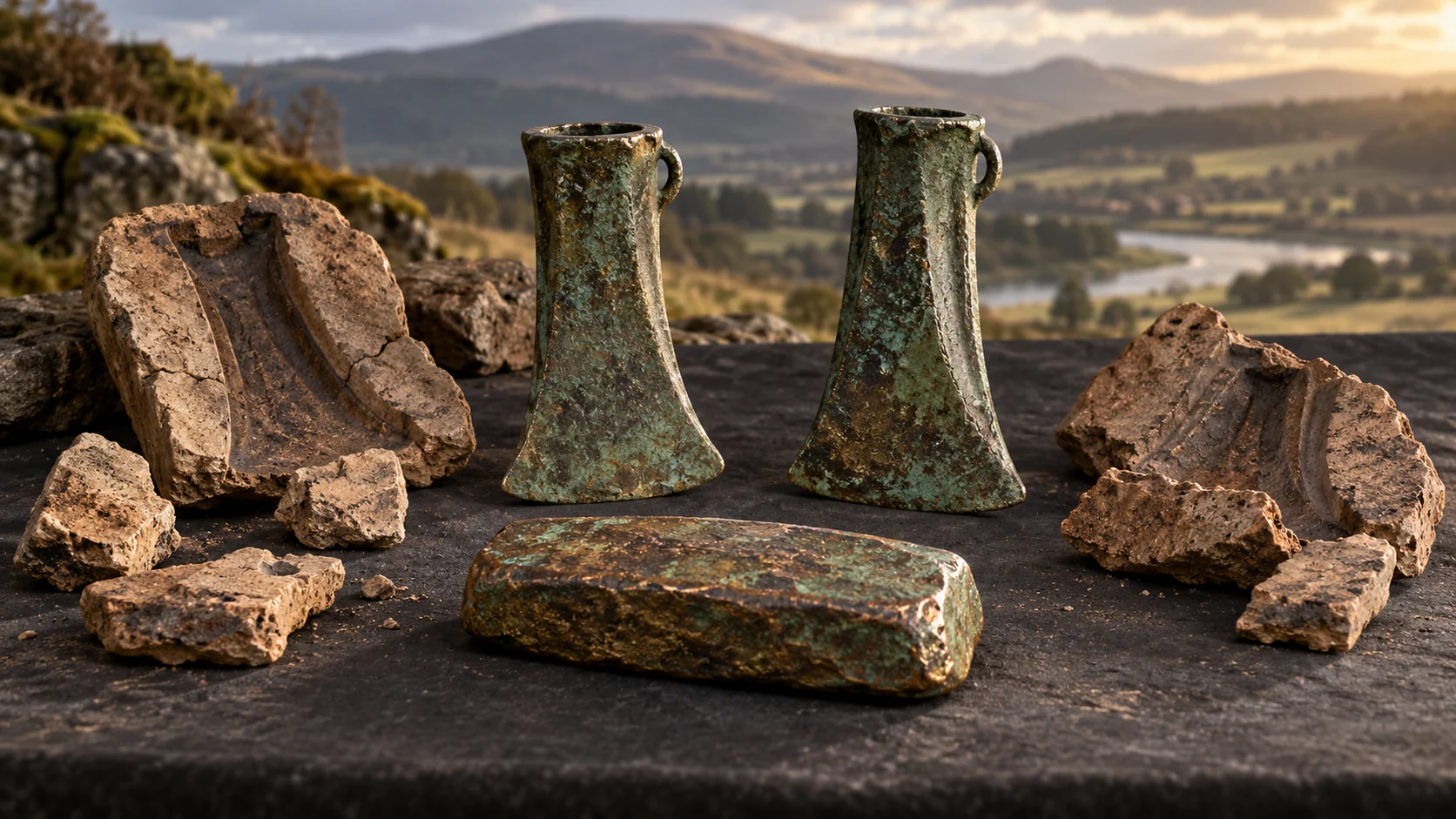
That group is the Blyth Hoard. National Museums Scotland announced its significance on 7 October 2026. It contains two bronze axe-heads, fragile clay mould material and a complete copper ingot. The museum says it is the first complete copper ingot found in Scotland.
The Blyth Hoard and the Peebles connection
There is another reason this find caught my eye. Stępień found the Peebles Hoard in 2020, only about seven miles away. That larger Late Bronze Age group includes distinctive bronze fittings.
According to National Museums Scotland, craftspeople may have used some Blyth moulds to make fittings like those at Peebles. Even so, the fragments are incomplete and extremely fragile, so researchers are still studying the link. It is an intriguing possibility, not proof that the same people made both hoards.
The copper ingot
An ingot is raw metal that craftspeople can melt down and make into other objects. The complete copper ingot gives researchers a rare chance to study the metal alongside moulds and finished bronze finds.
In time, analysis may show where the copper came from. That could tell us more about how Bronze Age craftspeople obtained their materials. So far, the finds do not prove a particular trade route or workshop.
The Blyth objects date to the Late Bronze Age, roughly 1150 to 800 BC. Archaeologists excavated them from an ancient stone cairn. They also found a layer of burnt material, though its meaning is still unclear.
Why stopping mattered
The find itself is fascinating, but Stępień’s decision to stop matters just as much. Once he realised there was more in the ground, he reported it to Scotland’s Treasure Trove Unit. National Museums Scotland says that prompt report let archaeologists recover the objects safely and keep the clues around them.
If a signal turns into a group of objects, those surrounding clues can tell a story that a single find cannot. Leaving the rest in place gives specialists the best chance to understand it.
Scotland has its own reporting system. The Portable Antiquities Scheme covers England and Wales, where Finds Liaison Officers help record finds. Our guide to the role of a Finds Liaison Officer explains how that neighbouring system works.
National Museums Scotland now holds the Blyth objects at its collection centre in Edinburgh, where staff are conserving and studying them. Research into both hoards continues.
Of all the Blyth finds, it’s the copper ingot that sticks with me. The axe-heads are finished objects; that piece of copper makes me wonder what someone might have made next. Did those moulds have anything to do with the fittings at Peebles? We don’t know yet, but I’ll be keen to see what the archaeologists uncover.