Every now and then a find comes along that reminds you exactly why we put up with the wet fields, ring pulls, shotgun caps and endless bloody moo tubes.
The Bickmarsh Hoard is definitely one of those finds.
Sixty-three coins, more than 1,100 years old, found in a Worcestershire field by a group of ordinary detectorists. Not only is it a cracking find in its own right, but it could also tell us something new about what was happening in this part of England during a pretty dangerous period of our history.
If you haven’t caught up with this one yet, here’s what was found, why the experts are interested and, importantly, how the detectorists handled the discovery properly from the start.
What was found at Bickmarsh?
The story started back in 2022 when members of Go Detecting (Midlands) Ltd were carrying out a survey in the parish of Bickmarsh, close to the Worcestershire and Warwickshire border.
At first, a few silver coins started appearing in the topsoil. Then a few more.
Anyone who has ever found a small coin scatter will know that feeling. One coin is nice. Two gets interesting. When they keep appearing you start wondering whether you’ve stumbled across something much bigger.
The group reported what they had found and Worcestershire County Council’s archaeology team became involved. From there it turned into a proper joint investigation.
A second metal detecting survey was carried out, followed by a geophysical survey and then a targeted archaeological excavation. Two further concentrations of coins were discovered and the excavation area was extended.
By the time everything was finished, 63 coins had been recovered. The collection is now known as the Bickmarsh Hoard.
The contents of the hoard are particularly interesting.
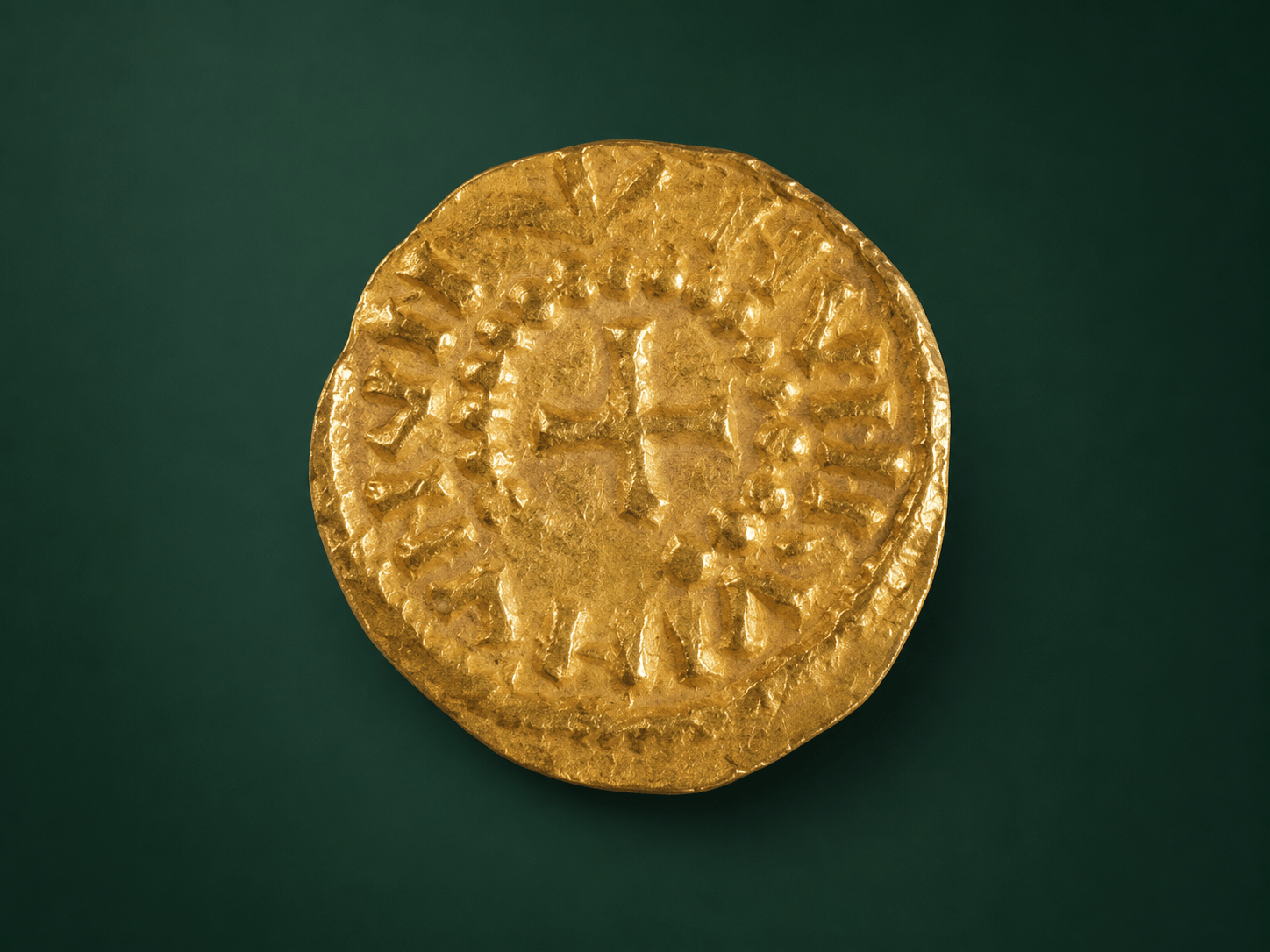
There is one gold solidus, two Frankish deniers from continental Europe and the remaining coins are Anglo-Saxon silver pennies of varying purity.
Most of the pennies were struck in the name of Burgred, King of Mercia between AD 852 and 874, using the “Lunettes” style which was also used by his brothers-in-law in Wessex.
A coin of Alfred is also included in the hoard, helping specialists date its burial to somewhere around AD 871 to 874.
Why is the Bickmarsh Hoard important?
Early medieval coins from roughly the fifth to early eleventh centuries are actually pretty rare finds in Worcestershire.
Before Bickmarsh, fewer than 100 coins from this entire period had been recorded across the county.
Eighteen of those came from the only other known ninth-century hoard in Worcestershire, the Severn Stoke Hoard, which was discovered around 22km to the west.
So this isn’t just another handful of hammered coins.
For Worcestershire, it’s a genuinely important discovery and helps fill in another small gap in what we know about the area during the ninth century.
Trying to put a modern value on the money is much more difficult.
Estimates for the buying power of a Saxon penny vary massively, from around £10 to £200 in today’s money, although figures somewhere around £20 to £50 are considered more realistic.
Using those estimates, the complete hoard could have represented something like £2,000 to £3,000 in modern terms.
Not exactly enough to retire on, but certainly enough money that whoever buried it would have intended to come back.
For whatever reason, they never did.
And that’s one of the things I love about finds like this. Someone stood in roughly the same spot more than 1,100 years ago, deliberately put their money into the ground and presumably thought they’d be returning for it.
We will probably never know why they couldn’t.
Was the hoard hidden because of the Vikings?
This is where things get even more interesting.
The obvious theory is that the money was buried to protect it from Viking armies, who were moving through England during this exact period.
But the evidence isn’t quite clear enough to say that for certain.
According to Gareth Williams, formerly the British Museum’s specialist in early medieval coinage, the two Frankish coins are particularly interesting.
Coins from northern continental Europe are unusual in Anglo-Saxon hoards, but they appear more frequently in discoveries connected with Viking activity.
Similar foreign coins have been found in the Watlington Hoard in Oxfordshire and the Herefordshire Hoard, both dating from the later 870s.
Those hoards also contained bullion, giving them a much stronger Viking connection. Bickmarsh, on the other hand, contains coins only.
So at the moment the honest answer is that nobody knows for certain who buried it or why.
The surviving written records don’t place Viking forces at Gloucester until around AD 877 or 878, several years after the Bickmarsh Hoard appears to have been buried.
The owner might have been worried about Viking attacks, or the hoard could have been hidden because of political trouble and fighting within Mercia itself.
Personally, I think that’s what makes discoveries like this even better.
History isn’t always as neat as it looks once it has been written into a book. Finds like this give us another piece of the puzzle, but sometimes they also create completely new questions.
What detectorists can take from the Bickmarsh Hoard
For me, one of the best parts of this story is how the discovery was handled.
The detectorists reported what they had found instead of simply carrying on digging and pocketing everything.
Because of that, archaeologists were able to investigate the site properly and record where the coins were actually sitting in the ground.
That context can sometimes be just as important as the coins themselves.
The archaeological team also recovered 35 small fragments of lead sheet from the same area.
There is currently no way of proving that the lead originally wrapped the coins, but other examples of lead-wrapped hoards are known from England.
It’s exactly the sort of question that can only be investigated properly when the original find location hasn’t been completely disturbed.
There is another lesson here too.
Most of these coins were sitting in the topsoil and had been scattered around by centuries of ploughing.
There was no huge hole or dramatic underground chamber. Just shallow signals sitting in an ordinary worked field.
It’s a good reminder that a field doesn’t have to look particularly exciting to have something incredible sitting underneath your coil.
And finally, it shows exactly why the Portable Antiquities Scheme and local Finds Liaison Officers are so important to metal detecting in the UK.
The discovery went through the proper process, with archaeologists, the coroner, the Portable Antiquities Scheme and Historic England all becoming involved.
Instead of 63 interesting coins disappearing into individual collections with very little information attached to them, we now know they formed part of a single ninth-century deposit and can study them together.
If you’re still unsure about what happens when you report an important find, or exactly where your local FLO fits into the process, have a read of our guide explaining what a Finds Liaison Officer actually does.
Hopefully most of us will never need one for anything more exciting than recording the occasional interesting find.
But you never know.
One day that scratchy little signal in the middle of an otherwise completely ordinary field might turn into something much bigger.
Well done to the lads from Go Detecting and everyone involved at Worcestershire’s archaeology service.
This is metal detecting at its best.
Sources
Information for this article was taken from reports published by Worcestershire County Council, Worcestershire Archive & Archaeology Service and Popular Science.
This article is an independently written Detectorist World summary based on the published information above. Follow the source links for the original reports, additional specialist information and photographs of the discovery.