Most of us have had one of those flat days. Another walk, another field, the coil swinging back and forth over ground that seems determined to give you nothing but ring-pulls, shotgun caps and bits of scrap.
That is more or less how metal detectorist Kevin Houghton described the day that eventually led to something rather different: a remarkable Iron Age hoard from the Cotswolds containing more than 160 coins and a collection of miniature ritual objects dating back around 2,000 years.
The finds have now been declared Treasure and secured by the Corinium Museum in Cirencester. Even better, archaeological work carried out after the discovery has revealed that the hoard appears to have formed part of a much larger Iron Age ritual site.
At a glance: The hoard contains more than 160 Iron Age coins associated with the Dobunni tribe, together with miniature shields and spearheads believed to have been deposited as ritual offerings. Corinium Museum raised £13,250 to acquire the assemblage and is now raising £25,000 for its conservation and display.
What Was Found?
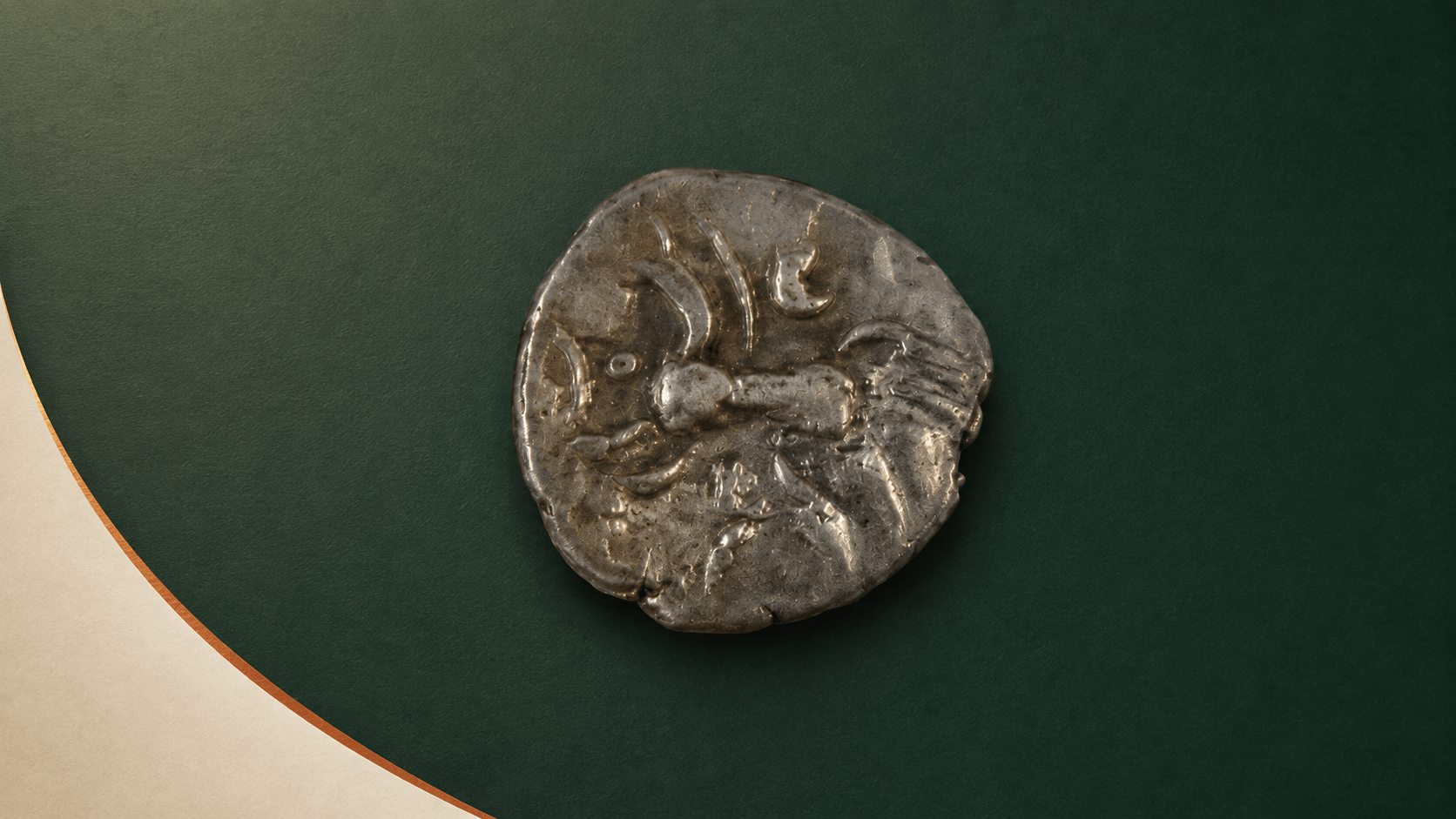
The original discovery contained more than 160 Iron Age coins, many of them silver, alongside miniature iron and copper-alloy shields and spearheads.
Those tiny weapons are an important part of the story.
They were not toys and they were not simply scraps of metal that happened to be buried alongside the coins. Archaeologists believe they were votive objects: miniature items deliberately made and deposited as offerings.
The main assemblage dates to around the late 1st century BC, placing it right at the end of the British Iron Age and not long before the Roman conquest of Britain began in AD 43.
What started as an impressive metal detecting find has therefore turned into something much bigger: evidence of what appears to have been an important ritual site used by people living in the Cotswolds around two thousand years ago.
Whose Coins Were They?
This was Dobunni territory.
The Dobunni were an Iron Age people whose territory covered much of what is now Gloucestershire and surrounding parts of south-west Britain. Their coinage is particularly distinctive, and many of the coins within the hoard feature the familiar three-tailed horse motif associated with Dobunnic coins.
If you have ever tried identifying a worn Iron Age coin from a slightly questionable phone photograph, that three-tailed horse is one of the more helpful clues you can hope to find.
There is another interesting connection nearby.
Bagendon, just a few miles from the discovery site, was an important Iron Age settlement or oppidum. Archaeological evidence from Bagendon shows that coins were being produced locally, giving researchers another piece of the puzzle when trying to understand the people who lived in this part of Britain before the Roman invasion.
The Site Turned Out to Be Even More Important
The story did not end when the coins came out of the ground.
Archaeologists from the Royal Agricultural University later returned to the area and, working with the original finder and landowner, were able to relocate the hoard pit and investigate the surrounding archaeology.
What they found changed the interpretation of the discovery completely.
The hoard had apparently been deposited within a larger sacred area containing a heavily worn cobbled surface. Archaeologists also uncovered iron spears driven into the ground, miniature bronze spears, model swords, scabbards, daggers and shields.
Some of the miniature objects had apparently been deliberately broken before deposition, something archaeologists believe may have formed part of the ritual itself.
Rather than somebody simply burying their savings and never returning for them, the evidence increasingly points towards a place where valuable and symbolic objects were deliberately offered as part of Iron Age religious practice.
Professor Mark Horton, who led the archaeological work, described the site as providing rare direct evidence of religious practices at the very end of the Iron Age.
That archaeological context is exactly why recording the location of significant metal detecting finds properly matters so much.
Why Corinium Museum Wanted the Hoard
Corinium Museum raised £13,250 to acquire the hoard, with support from the Art Fund and the Arts Council England/V&A Purchase Grant Fund.
It will become the first Iron Age coin hoard in the museum’s collection.
For the museum, the importance is not simply the number of coins. The assemblage combines coinage, miniature weapons and archaeological context, allowing the objects to tell a much wider story about Iron Age identity, craftsmanship and belief in the Cotswolds.
It also fits particularly well with the museum’s existing interpretation of nearby Bagendon and local Iron Age coin production.
Once conserved, the hoard is expected to become a focal point of Corinium Museum’s Iron Age gallery.
£25,000 Is Still Needed for Conservation
Buying an archaeological assemblage is only part of the job.
The Friends of Corinium Museum are now trying to raise a further £25,000 to conserve and display the objects, with the aim of putting the hoard on public display in 2027.
Conservation might be the less glamorous part of the story, but it is an essential one. Objects that have spent around two thousand years underground cannot simply be cleaned up and dropped into a display case.
They need to be assessed, stabilised, conserved and stored under suitable conditions if they are going to survive for future generations.
Anyone interested in supporting the project can find details on the Corinium Museum Iron Age Hoard fundraising page.
Why This Discovery Matters to Detectorists
For detectorists, there is another reason this story is worth paying attention to.
It is a very good example of what can happen when an important find is properly recorded and reported.
The original discovery went through the Treasure process, the location was preserved, archaeologists were able to return to the site and the later excavation revealed an archaeological story that could easily have been missed.
Without that findspot information, we might have ended up knowing that 160-odd Iron Age coins existed but very little about why they were buried there.
Instead, researchers now have evidence suggesting that the coins formed part of a much larger ritual landscape.
That difference is enormous.
If you ever uncover a concentration of unusual objects, a hoard or something you think could meet the legal definition of Treasure, resist the temptation to keep chasing signals until everything is out of the ground. Record the location carefully and get advice.
You can read our full UK metal detecting laws and code of conduct guide for an explanation of the Treasure process and your responsibilities as a detectorist.
We also have a free Potential Treasure Action Checklist and Treasure Find Record Form in the Detectorist World free resources section, which are worth saving before you actually need them.
One of Those Days That Changes Very Quickly
There is something about finds like this that every detectorist can relate to, even if most of us are unlikely to uncover 160 Iron Age coins.
You can walk the same sort of fields, dig the same rubbish and listen to the same unpromising signals for hours. Then a single target changes the whole day.
In this case, it eventually did rather more than that.
A metal detecting discovery led archaeologists back to a place where people were apparently gathering, making offerings and practising their beliefs around two thousand years ago.
And instead of disappearing into separate collections, the objects and the story behind them will remain together, close to where they were originally buried, for the public to see.
Not bad for another walk across another Cotswold field.
Sources and Further Reading
This article was independently written by Detectorist World using information published by the organisations and news outlets involved in reporting and investigating the discovery.
- BBC News: coverage of the Cotswolds Iron Age discovery
- Corinium Museum: Iron Age coin hoard acquisition
- Corinium Museum: archaeological investigation of the votive site
- Royal Agricultural University: archaeological excavation and interpretation
- Cotswold District Council: Corinium Museum acquisition announcement