The quick answer
In the UK, you can legally metal detect on land where you have permission from the landowner, and where the land is not protected, restricted or otherwise off limits. This usually means private permissions, organised club digs, some beaches, gardens with permission, and certain council or public land only where specific consent has been given.
The rule to remember:
Public access is not the same as metal detecting permission. A public footpath means you can walk across it. It does not mean you can detect, dig or remove finds.
UK metal detecting laws
Where Can You Legally Metal Detect In The UK?
A beginner-friendly guide to where you can detect, where you need permission, and the places you should leave well alone unless you have the correct consent.
Quick disclaimer:
This guide is for general information only and is not legal advice. Rules can change, local councils have their own policies, and different parts of the UK have different systems. Always check before you go detecting, and read the full UK Metal Detecting Laws & Code Of Conduct guide before your first proper outing.
So this guide is here to give you a clear beginner-friendly answer. Where can you detect? Where do you need permission? Where should you avoid? And where are the best places to start if you are new and do not yet have a private permission?
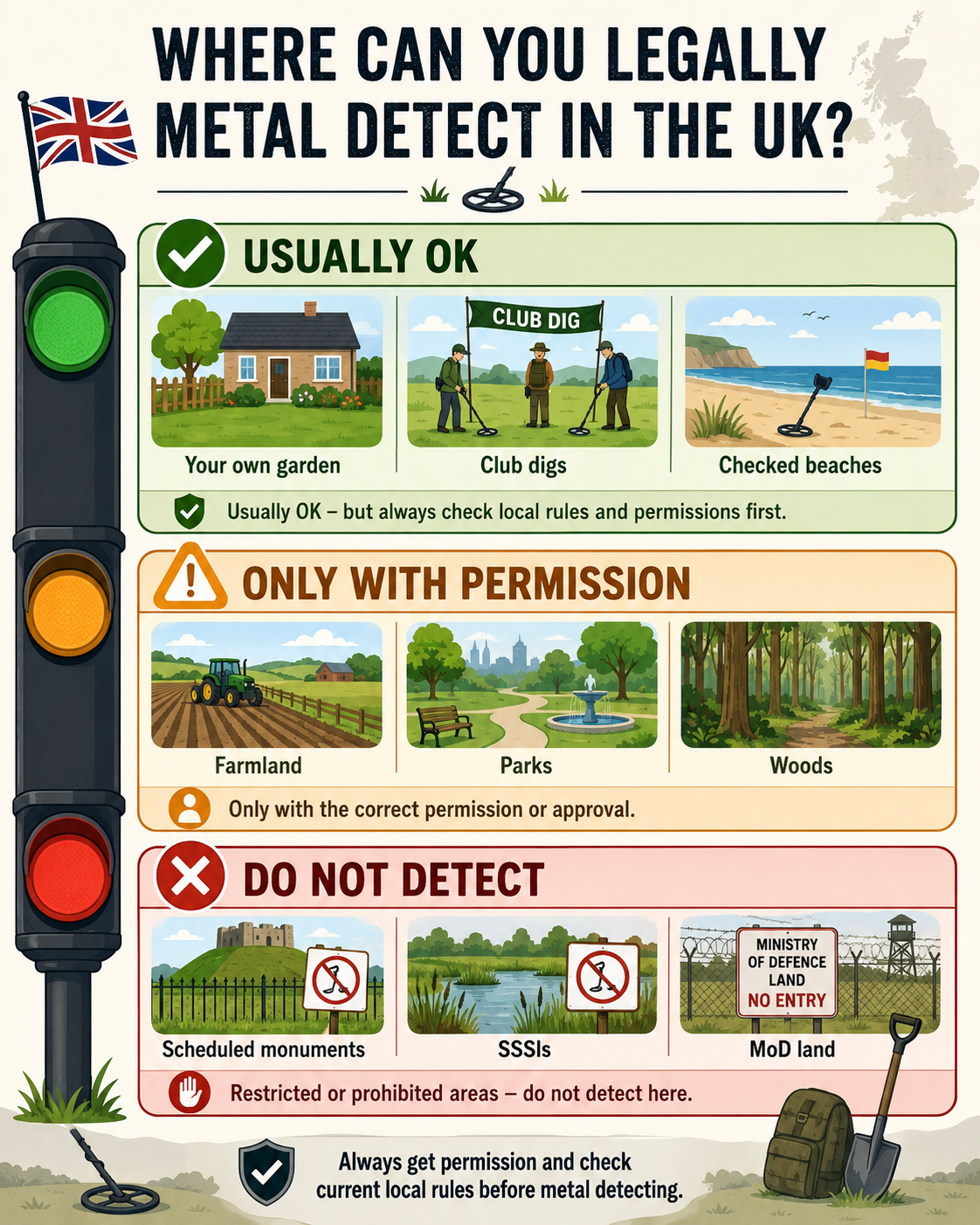
Where can you metal detect? At a glance
This table gives you the simple version. The detailed explanations come after it.
| Place | Can you detect there? | What permission do you need? | Beginner note |
|---|---|---|---|
| Your own garden | Usually yes | Your own permission, or the homeowner’s permission | Great place to practise before going on proper land. |
| Private farmland | Yes, with permission | Landowner and possibly tenant farmer | Often one of the best types of permission. |
| Organised club digs | Usually yes | Arranged by organiser, but follow their rules | One of the easiest beginner routes. |
| Beaches | Sometimes | Depends on ownership and restrictions | Crown Estate foreshore is often possible, but check first. |
| Public footpaths | Not automatically | Landowner permission | A right to walk is not a right to detect. |
| Public parks | Only if allowed | Council or landowner permission | Many councils say no, but policies vary. |
| Woodland | Only with permission | Landowner or managing body | Do not assume woods are free to detect. |
| Common land | Not automatically | Relevant owner, authority or rights holder | Common does not mean nobody owns it. |
| Scheduled monuments | No, unless official consent | Historic England, Cadw or equivalent consent | Treat as off limits for normal hobby detecting. |
| SSSIs | Only with the correct consent | Landowner and Natural England where required | Check carefully before detecting. |
| National Trust land | Generally no without formal agreement | National Trust Archaeological Research Agreement | Not a casual permission route. |
The golden rule: all land is owned
If you take one thing from this guide, make it this:
All land is owned by someone.
That includes fields, parks, footpaths, woods, beaches, commons, riverbanks, village greens, roadside verges and bits of land that look abandoned. Somebody owns it, manages it, leases it, controls it or has responsibility for it.
For metal detecting, permission is not just about walking on the land. You are also searching, digging and potentially removing objects from the ground. That is why the permission standard is higher than simply being allowed to walk there.
Beginner mistake:
Thinking “public” means “free to detect”. It does not. A public footpath gives a right of passage. A public park may be open to visitors. Neither automatically gives you permission to metal detect.
On private land, the safest approach is to get permission clearly and preferably in writing. If a farm is tenanted, it is worth understanding whether you need permission from both the landowner and the tenant farmer.
For help with the asking side, read: How To Get Permission To Metal Detect
The best legal places to start metal detecting
If you are brand new, do not make life harder than it needs to be. Start with places where permission is clear, risk is low, and you can learn your detector without feeling like you are doing something wrong.
1. Your own garden
Not always exciting, but perfect for learning your machine, testing signals and practising neat digging. Older gardens can sometimes surprise you.
2. Family and friends’ gardens
Ask nicely, explain you will dig carefully, and avoid ruining anyone’s lawn. This is a great way to practise before approaching farmers.
3. Club digs
Organised club digs are one of the easiest routes for beginners because the organiser has normally arranged the land permission.
4. Properly checked beaches
Some beaches are good beginner places, especially dry sand, but always check ownership, local restrictions and protected areas first.
5. Private permissions
Farmland and pasture can be fantastic, but you need to earn trust, get permission and respect the land.
6. Organised rallies
Rallies can get you onto land you would never access alone, but check the organiser, rules, insurance and reporting process.
Can you metal detect on farmland?
Yes, farmland can be one of the best places to metal detect in the UK, but only with permission.
Farmers’ fields, pasture and ploughed land have produced some incredible finds over the years. It makes sense really. People travelled across fields, worked on the land, lived near old settlements, lost coins, dropped buttons, broke tools, gathered at old routes and left traces behind them.
But farmers are understandably protective of their land. They have crops, livestock, machinery, insurance, biosecurity, gates, tracks and business operations to worry about. You turning up with a detector is not automatically a welcome sight.
Before detecting on farmland, check:
- Do you have permission from the correct person?
- Is the land owned or tenanted?
- Are there crops, livestock or farm operations to avoid?
- Where should you park?
- Which fields are included and which are not?
- Are there any protected sites, stewardship restrictions or known archaeological areas?
- What is the agreement about finds?
Farmland permission is not just a “yes” and off you go. A good permission should be clear. Know where you can detect, when you can go, whether you need to call first, what happens with finds, and how the landowner wants to be updated.
Full guide: How To Get Permission To Metal Detect
Can you metal detect on UK beaches?
Beaches are one of the more realistic places for beginners to start, but they are not all automatically free-for-all detecting land.
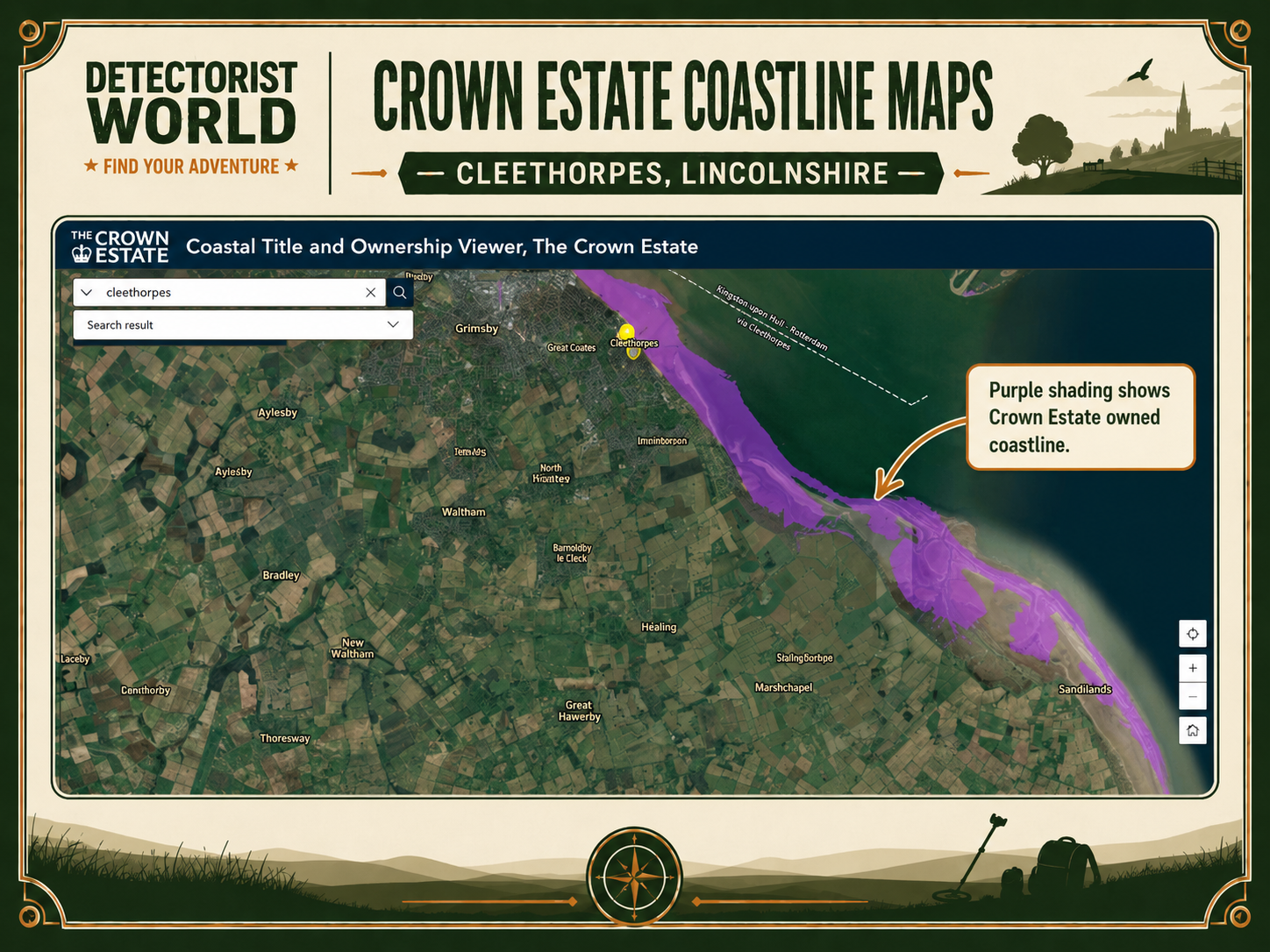
The Crown Estate owns areas of foreshore around England, Wales and Northern Ireland. On Crown Estate foreshore, detectorists are generally granted a permissive right to metal detect without applying for a formal permit, as long as they follow the conditions.
However, that does not mean every beach is covered. Some beaches are privately owned, council managed, protected, restricted or affected by local rules. The Crown Estate arrangement also does not cover the seabed, riverbeds or other Crown Estate land. The River Thames foreshore needs a separate permit from the Port of London Authority. You can view the interactive Crown Owned Coastline map here.
Before beach detecting, check:
- Is the foreshore owned by The Crown Estate?
- Are there local council restrictions?
- Is the area an SSSI, nature reserve or conservation area?
- Does the beach have seasonal restrictions?
- Are you near the River Thames foreshore?
- Are you detecting between mean high water and mean low water, not seabed or riverbed?
From a detecting point of view, dry sand is easier for beginners. Wet salt sand can make some detectors unstable, especially basic single-frequency machines. That is a detector performance issue rather than a legal one, but it is still worth knowing before you plan a beach day.
Official guidance: The Crown Estate’s coastal metal detecting rules
Can you metal detect on public footpaths?
This is one of the most misunderstood areas for beginners.
A public footpath gives the public the right to pass and repass. In normal English, that means you can walk along it. It does not give you the right to metal detect, dig holes, remove objects or wander away from the path into the field.
The land still belongs to someone. Usually a farmer, estate, private landowner, council or other body. You still need permission from whoever owns or controls the land.
Plain English version:
You can walk a public footpath. You cannot automatically detect it. The right of way is for walking, not digging.
Public footpaths can be historically interesting, especially old routes, but that does not change the permission requirement. If a footpath crosses a farm permission you already have, ask the landowner whether the path area is included before you detect it.
More detail: the full UK metal detecting laws guide
Can you metal detect in parks and council land?
Sometimes, but do not assume.
Parks, playing fields, commons, recreation grounds and council-owned land are controlled by local authorities or other landowners. Some councils have clear policies. Some allow detecting with written permission. Some have designated areas. Some do not allow it at all.
The frustrating bit is that there is no single UK-wide answer. One council may allow metal detecting in certain places with permission, while another may say no across the board.
Do not just turn up
Open public access does not equal detecting permission.
Check council policy
Search the council website or contact parks, open spaces or estates departments.
Get it in writing
A casual phone “probably fine” is not as useful as written permission.
Parks can be productive because people have gathered, played, picnicked, watched events and lost coins there for years. But they are also sensitive because of lawns, public safety, children, dogs, sports pitches and council maintenance.
If you do get permission, dig neatly, avoid busy times and leave no trace.
Can you metal detect in woods?
Only with permission.
Woodland can look wild and ownerless, but it is not. It may be privately owned, managed by an estate, owned by a charity, controlled by a public body, or protected for wildlife or heritage reasons.
Woods can be interesting places to detect because of old paths, boundaries, charcoal burning, military activity, lost settlements, hunting areas and old estate use. But woodland can also contain protected habitats, tree roots, archaeology and access restrictions.
Before detecting woodland, ask:
- Who owns or manages the woodland?
- Is detecting allowed?
- Are there protected habitats or SSSI restrictions?
- Are there scheduled monuments or known archaeological sites?
- Can you dig without damaging roots or paths?
- Are there public access rules or private restrictions?
If you get woodland permission, be extra careful with digging. Tree roots and archaeology are not things to hack through because you got an iffy signal.
Worth knowing: Forestry England land has its own access rules, so check the relevant estate or site guidance before detecting
Are metal detecting clubs and rallies legal?
Yes, properly organised club digs and rallies can be completely legitimate, and they are often brilliant for beginners.
The organiser should have arranged permission from the landowner, set the rules, explained parking, outlined any crop or boundary restrictions, and made sure everyone understands what happens with finds.
But do not assume every event is well organised just because someone posted it on Facebook. A responsible organiser should be clear about land permission, insurance expectations, reporting finds, boundaries and behaviour on the day.
Beginner tip:
A club dig is not just a place to find things. It is a place to learn. Watch how experienced detectorists swing, dig, check signals, record finds and deal with landowners.
You can start here: Find Metal Detecting Clubs
Places you should treat as off limits
Some places are not suitable for casual hobby detecting. Some are legally protected. Some are dangerous. Some need specialist consent that normal hobby detectorists are very unlikely to get.
| Place | Why it is a problem | Beginner advice |
|---|---|---|
| Scheduled monuments | Nationally important historic sites with legal protection. | Do not detect without official written consent. |
| SSSIs | Protected for wildlife, geology or scientific interest. | Check with landowner and Natural England where required. |
| MoD land | Restricted and potentially dangerous, including unexploded ordnance risk. | Avoid unless you have explicit official permission. |
| National Trust land | The National Trust has a controlled archaeological research agreement process. | Not a normal casual detecting route. |
| Known archaeological sites | Detecting can damage context and may breach agreements or restrictions. | Check before you detect, especially on stewardship land. |
| Railway land, roadsides and infrastructure | Safety, ownership and access issues. | Do not detect without proper permission. |
If a place feels legally complicated, protected, dangerous or too good to be true, pause and check before you go. A few minutes of checking is better than losing your detector, your permission, or worse.
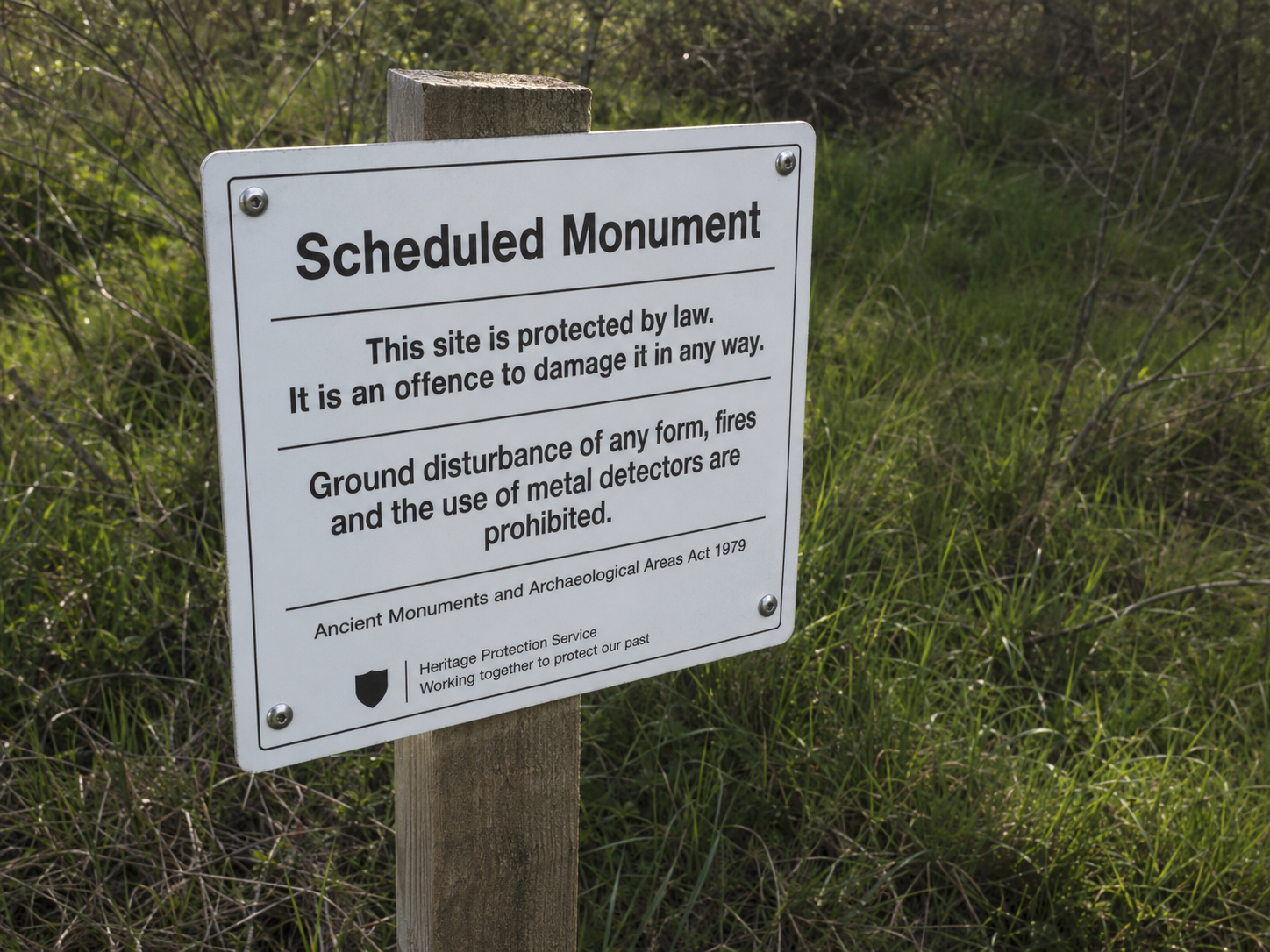
Scheduled monuments: do not guess
Scheduled monuments are nationally important archaeological or historic sites. These can include hillforts, Roman sites, medieval earthworks, burial mounds, deserted settlements and other protected places.
For normal hobby detectorists, the safest practical advice is simple: do not detect on a scheduled monument.
Official consent is required to use a metal detector on a scheduled monument. That is not the same as asking the farmer if it is okay. Even if the landowner likes you and gives permission for the surrounding field, that does not override scheduled monument protection.
How to reduce the risk
- Check the National Heritage List for England before detecting new land in England.
- Use the relevant heritage map or database for Wales, Scotland or Northern Ireland.
- Ask the landowner if they know of protected sites, but do not rely only on their memory.
- Stay well away from visible earthworks, mounds, ruins and obvious historic features unless you have proper advice.
This is one of those areas where “I did not know” is not a good plan.
What about SSSIs and protected natural sites?
SSSI stands for Site of Special Scientific Interest. These places are protected because of their wildlife, plants, geology or scientific value.
The important beginner point is this: do not assume you can detect on an SSSI just because you have landowner permission. Some activities need consent from Natural England, and protected land can carry restrictions that are not obvious when you are standing there with a detector.
This matters on beaches as well as inland sites. Some beaches, dunes, mudflats and coastal areas can have conservation designations.
Simple rule:
If the land is designated or protected, check properly before detecting. Do not rely on “it looks fine”.
Does this apply to Scotland and Northern Ireland?
Not fully.
England and Wales are usually what people are talking about when they discuss the Treasure Act, PAS and FLO reporting process. Scotland and Northern Ireland are different enough that you should not casually apply English advice to them.
Scotland
You still need landowner permission to detect, but finds law is different. Portable antiquities of archaeological, historical or cultural significance are dealt with through Scotland’s Treasure Trove system, under which all finds (not just gold and silver) can be claimed by the Crown and must be reported. Check the current Scottish guidance before detecting.
Northern Ireland
Northern Ireland has much stricter restrictions around searching for archaeological objects, and a licence is required. See the official Northern Ireland guidance for finders. Do not assume normal recreational detecting rules from England and Wales apply there.
My advice is simple. If you are detecting outside England and Wales, pause and read the correct local guidance first. It is not worth guessing.
What should you check before detecting somewhere new?
Before you go detecting on any new land, run through a simple checklist. This will save you a lot of worry and may save you from accidentally doing something stupid.
1. Ownership
Who owns the land, manages it or controls day-to-day access?
2. Permission
Do you have clear permission to detect, dig and remove finds?
3. Protected sites
Is it scheduled, an SSSI, a known archaeological site or otherwise restricted?
4. Finds agreement
What happens if you find coins, artefacts or something valuable?
5. Access rules
Where can you park, which fields are included, and when can you visit?
6. Reporting
Do you know what to do if you find Treasure, human remains or live ammunition?
Legal detecting also means dealing with finds properly
Being allowed to detect somewhere is only half the job. You also need to know what to do when you find something.
Most finds will not be Treasure. They may still be interesting and worth recording with the Portable Antiquities Scheme, but they will not all trigger the legal Treasure process. The Treasure rules changed in 2023, so some finds may qualify because of historical or cultural significance as well as their material or age. Being over 200 years old does not automatically make an object Treasure, so seek advice if you are unsure.
If you find something that might be Treasure, stop and get advice. Record the exact location, tell the landowner, and contact your local Finds Liaison Officer. Possible Treasure must be reported within 14 days.
If you find live ammunition, unexploded ordnance or suspected human remains, do not move it, do not poke it, do not put it in your finds pouch like a lunatic. Mark the area safely and contact the police.
Good detectorist habit:
Keep notes. Field, date, rough grid reference, depth, object type and photos. Even simple finds are more useful when you know where they came from.
Official process: Report treasure on GOV.UK
Where I would start as a beginner
If I were starting again from scratch, I would not overcomplicate it.
I would test my detector in the garden first. Then I would join a local club or attend an organised dig. At the same time, I would start slowly asking for private permissions, beginning with people I already know or landowners where I had some kind of local connection.
I would also try a properly checked beach session if I lived close enough to the coast. Beach detecting is not always easy, especially on wet sand, but it can be a nice way to get out and learn without the pressure of asking a farmer straight away.
Beginner route I recommend:
- Practise in your own garden or a family garden.
- Join a club or attend an organised dig.
- Learn the laws and code of conduct.
- Try a checked beach if suitable.
- Start asking for private permissions politely.
- Record finds and build a good reputation.
The biggest thing is to start responsibly. The hobby depends on trust, and trust is built by detectorists doing things properly.
Summary: where can you legally metal detect?
You can legally metal detect in the UK where you have the correct permission and where the land is not protected, restricted or otherwise off limits.
The best beginner options are your own garden, gardens of family and friends with permission, organised club digs, properly checked beaches, and private permissions where the landowner has clearly agreed.
You cannot automatically detect public footpaths, woods, parks, commons or council land just because people can access them. Public access is not the same as detecting permission.
You should avoid scheduled monuments, protected natural sites, MoD land, National Trust land without formal agreement, and anywhere legally restricted unless you have the correct official consent.
Keep it simple. Ask first. Check protected status. Get permission in writing where possible. Fill your holes. Take rubbish home. Report important finds properly. Do that, and you will already be ahead of a lot of beginners.
Next beginner guide
Need help getting your first permission?
Once you understand where you can legally detect, the next step is learning how to ask landowners properly and improve your chances of getting a yes.
FAQs about where you can metal detect in the UK
Is metal detecting legal in the UK?
Yes, metal detecting is legal in the UK, but only when done with the correct permission and in places where detecting is not restricted or prohibited.
Can I metal detect in a public park?
Not automatically. Public parks are usually owned or managed by a council or other landowner. You need to check their rules and get permission where required.
Can I metal detect on a public footpath?
No, not without landowner permission. A public footpath gives you the right to walk, not the right to metal detect, dig or remove finds.
Can I metal detect on farmland?
Yes, if you have permission from the correct person. If the land is tenanted, you may need permission from both the landowner and tenant farmer.
Can I metal detect on the beach?
Sometimes. Crown Estate foreshore can generally be detected under a permissive right, but not every beach is Crown Estate foreshore, and local restrictions, protected areas and Thames foreshore permit rules may apply.
Can I metal detect in woods?
Only with permission from the landowner or managing body. Woodland may also have wildlife, heritage or access restrictions.
Can I metal detect on common land?
Not automatically. Common land is still owned or managed, and there may be additional rights and restrictions. You need to identify who can give permission.
Can I metal detect on a scheduled monument?
Not without official consent from the relevant heritage authority. For normal hobby detecting, scheduled monuments should be treated as off limits.
Where is the easiest place for beginners to start?
Your own garden, family gardens with permission, organised club digs and properly checked beaches are usually the easiest starting points while you learn your detector and build confidence.
Sources and further reading
These links support the guidance above and provide further reading. Check country-specific rules where noted.
- The Crown Estate: Metal detecting and drone flying: Current guidance on Crown Estate foreshore, permissions and exclusions.
- Historic England: Scheduled Monument Consent: Explains restrictions on detecting and removing objects from scheduled monuments.
- GOV.UK: Sites of Special Scientific Interest: Explains that SSSI restrictions and consent requirements are site-specific in England.
- GOV.UK: Treasure Act 1996 Code of Practice: The current Treasure Act framework for England, Wales and Northern Ireland.
- nidirect: Archaeology and treasure: Official Northern Ireland rules on licences, protected sites and reporting finds.
- Treasure Trove Scotland: Information for finders: Official Scottish guidance on permission, protected sites and reporting portable antiquities.