The quick answer
To identify a metal detecting find, photograph it clearly, record where it was found, measure it, weigh it if possible, note the material, shape, decoration and any marks, then compare it with trusted sources such as the Portable Antiquities Scheme database, coin catalogues, specialist find websites, books, forums, AI tools and your local Finds Liaison Officer.
The golden rule:
Do not force an identification because you want it to be exciting. Let the evidence lead you.
Finds identification guide
How To Identify Metal Detecting Finds
A practical beginner guide to working out what you have found, where to look online, when to use AI or apps, and when to stop guessing and ask your Finds Liaison Officer.
Important before we start:
This guide is for general identification help, not professional archaeological advice. If your find may be Treasure, very old, fragile, unusual, part of a hoard, or potentially important, do not clean it heavily or sell it. Record the find spot, tell the landowner, keep it safe and contact your local Finds Liaison Officer.
This guide will walk you through a sensible identification process, the best places to look online, how AI and apps can help, and the common types of metal detecting finds beginners are likely to dig.
Before identifying a find, do not clean it too much
I know the temptation. You get home, you have a muddy object in your hand, and all you want to do is clean it until the answer appears.
The problem is that cleaning can remove the very clues you need.
A maker’s mark, surface detail, patina, gilding, decoration, lettering or tiny bit of remaining design can be damaged by scrubbing, soaking or polishing. Once that has gone, it has gone.
Before you clean anything properly, take photos. Ideally take photos exactly as found, then gently remove loose soil only if needed. If it may be old or important, pause and ask for advice before doing more.
Beginner mistake:
Cleaning first and identifying later. Do it the other way round. Identify first, clean carefully afterwards if it is safe to do so.
For more detail, read: How To Clean Metal Detecting Finds Without Ruining Them
A simple find identification process
When you have an unknown find, do not jump straight to “Roman” or “medieval” because that is what you would like it to be. Work through the clues properly.
Step-by-step method
- Photograph both sides before cleaning.
- Record where it was found.
- Measure the length, width and thickness.
- Weigh it if you have small scales.
- Look at the material and colour.
- Check for marks, holes, loops, hinges, pins, decoration or writing.
- Think about what job the object may have done.
- Compare it with trusted sources.
- Ask for help if you cannot identify it confidently.
The “what job did it do?” question is really useful. A lot of finds are functional objects. They fastened clothing, held straps, sealed bags, weighed goods, decorated harness, marked trade, fired from weapons, fixed furniture or formed part of a larger item.
Once you start thinking in terms of function, mystery objects become a little less mysterious.
How to photograph finds for identification
Poor photos make identification much harder.
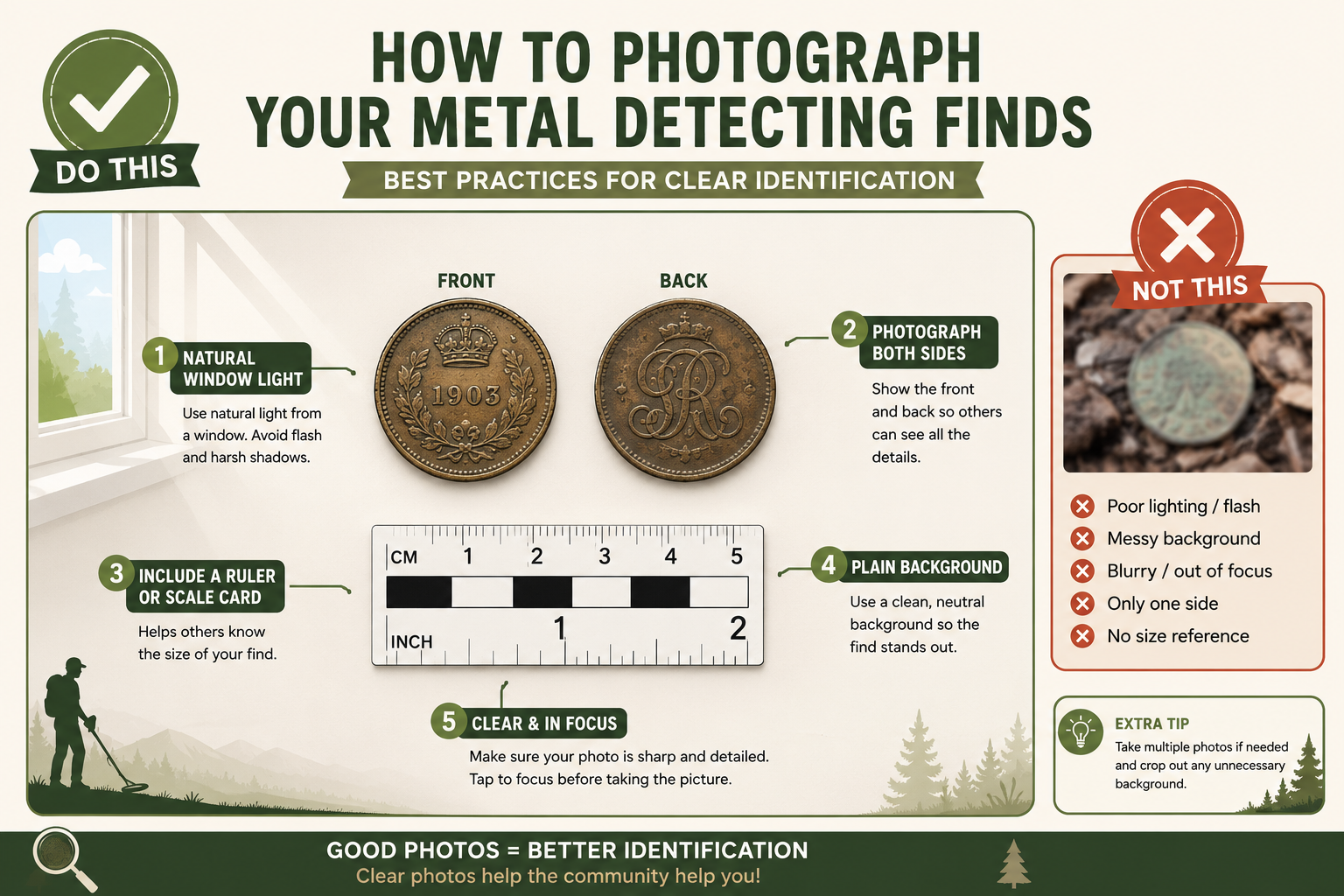
We have all seen those photos where someone posts a blurry brown blob on Facebook, taken in a dark kitchen from six feet away, with the caption “Any ideas?” It might be a Roman brooch. It might be a bit of tractor. Nobody can tell because the photo looks like it was taken during an earthquake.
Good photos do not need fancy equipment. A phone camera is usually fine if you use it properly.
Use natural light
Daylight near a window is usually better than harsh flash or yellow indoor lighting.
Photograph both sides
Front, back, edges and close-ups of any marks or decoration all help.
Add scale
Use a ruler, coin scale card or measuring tape so people know the size.
Keep it sharp
Tap to focus, hold still, and take several photos rather than trusting one blurry shot.
The clues that help identify a find
Most finds give you clues if you slow down and look properly.
| Clue | What to look for | Why it matters |
|---|---|---|
| Material | Copper alloy, lead, iron, silver, gold, pewter or aluminium. | Different materials were used for different objects and periods. |
| Shape | Round, flat, looped, curved, pointed, rectangular, hollow or broken. | Shape often hints at function. |
| Size and weight | Exact measurements and weight if possible. | Coins, weights, tokens and artefacts often need size comparison. |
| Attachment points | Loops, holes, rivets, shanks, pins, hinges or hooks. | Shows how the item was worn, fastened or fixed. |
| Decoration | Patterns, gilding, lettering, symbols, stamps or moulded detail. | Can help date and identify the object. |
| Wear and damage | Breaks, bends, worn edges, corrosion or clipped areas. | Helps work out whether it is complete, broken or part of something larger. |
Common metal detecting finds and what they might be
Beginners often expect coins and treasure. In reality, you will dig a huge mix of ordinary, confusing and occasionally exciting objects.
This table gives you a starting point. It is not a final identification guide, because condition, size, material and context all matter.
| Find | What it might be | Identification clues | Beginner note |
|---|---|---|---|
| Copper disc | Coin, token, washer, button or blank disc. | Look for edge, portrait, lettering, thickness, shank marks or hole. | Do not assume every round thing is a coin. |
| Lead ball | Musket ball, pistol shot, ball bearing, fishing weight or scrap lead. | Check weight, diameter, casting seam, impact marks and context. | Lead balls are common and not all are military. |
| Flat lead disc | Token, weight, seal, gaming piece or scrap. | Look for stamped marks, holes, numbers, initials or decoration. | Photograph carefully before brushing. |
| Button | Clothing button, livery button, military button or decorative mount. | Look for shank, maker’s mark, crest, military design or gilding. | Back marks can be more useful than the front. |
| Buckle frame | Shoe buckle, knee buckle, harness buckle, belt buckle or medieval buckle. | Check frame shape, pin bar, decoration, size and metal type. | Buckles can be hard to date without comparison examples. |
| Small ring | Harness ring, curtain ring, medieval annular brooch, modern ring or scrap. | Look for wear, pin marks, decoration, casting seam and material. | A ring-shaped object can be many things. |
| Decorated copper-alloy fragment | Mount, strap fitting, brooch fragment, furniture fitting or harness decoration. | Check for rivets, gilding, broken edges, pins and decoration. | This is where FLO or PAS comparison can really help. |
| Thimble | Sewing thimble, ring thimble or modern thimble. | Look at shape, dimples, open top, closed top and material. | Thimbles can vary widely in age. |
| Bag seal | Lead seal from seed, fertiliser, cloth, customs or trade goods. | Look for lettering, numbers, holes or wire channel. | Often more interesting than they first look. |
| Shotgun cap | Modern or older shotgun cartridge end. | Circular base, central primer, often with maker text. | You will dig loads. Sorry. |
| Odd iron object | Nail, tool, horse tack, machinery part, weapon fragment or farm scrap. | Shape, weight, context and whether it has a recognisable function. | Most iron is scrap, but not all of it. |
| Modern aluminium shape | Ring pull, foil, can slaw, tube, wrapper or farm rubbish. | Lightweight, silvery, often torn or folded. | Sadly excellent at sounding better than it deserves. |
How to identify coins found metal detecting
Coins are usually the easiest finds to start researching, but badly worn coins can still be a pain.
Start with the basics: size, metal, thickness, visible lettering, portrait direction, shield, date, monarch, denomination and any edge detail.
A modern coin is usually easy. Victorian, Georgian and early milled coins can often be identified with enough remaining detail. Hammered coins and Roman coins can be trickier because they may be clipped, worn, off-centre, corroded or missing key parts of the design.
Coin identification checklist
- Photograph both sides straight on.
- Measure diameter in millimetres.
- Weigh it if possible.
- Note the metal colour.
- Look for any visible letters or numbers.
- Check for a portrait, bust, shield, cross or figure.
- Compare with coin databases and similar examples.
- Ask for help if it may be ancient, rare or Treasure.
Be careful with coin apps and AI here. They can be genuinely useful, but if a coin is worn, damaged or only partly visible, they may confidently suggest the wrong thing.
Treat app results as possible leads, not final answers.
Best websites for identifying metal detecting finds
There are a lot of places online where you can try to identify finds. The single best UK starting point is the Portable Antiquities Scheme database, and the UK Detector Finds Database (UKDFD) is another well-organised, detectorist-run reference. Some are excellent. Some are useful but messy. Some are full of confident guesses from people who have seen three buttons and now think they are the British Museum.
Use websites as part of the process, not as a replacement for proper advice when a find may be important.
| Website or resource | Best for | How to use it | Beginner caution |
|---|---|---|---|
| Portable Antiquities Scheme database | UK archaeological objects, coins and recorded finds. | Search by object type, material, period and location area. | Use for comparison and recording context, not as a treasure map. |
| Finds Liaison Officer | Important, unusual, reportable or hard-to-identify finds. | Send clear photos, measurements, weight and findspot information. | Do not expect instant replies, and do not clean important finds first. |
| UK Detector Finds Database | Detectorist-recorded finds and comparison examples. | Browse categories and compare shapes, materials and dates. | Still confirm anything important through proper channels. |
| Numista | World coins and banknotes. | Use country, metal, size, date, denomination and image search where helpful. | Less useful if your coin is extremely worn or fragmentary. |
| WildWinds | Ancient coins, especially Roman, Greek, Byzantine and Celtic examples. | Compare portraits, reverses, legends and rulers. | Can feel overwhelming for beginners. |
| Colchester Treasure Hunting finds index | Browsing lots of detector-found object types. | Use it for visual comparison and general object categories. | Do not treat visual similarity alone as proof. |
| Metal detecting forums and Facebook groups | Fast opinions and community help. | Post clear photos, size, weight, material and county-level location. | Expect guesses. Some will be wrong. |
Can AI and apps identify metal detecting finds?
Yes, AI and apps can help, but do not let them turn your brain off.
Tools like Google Lens, coin identification apps and AI image analysis can be useful for getting possible leads. They can spot visual similarities, suggest object categories, read visible text, compare coin designs and help you think of search terms you might not have considered.
But they can also be wrong. Very wrong. And sometimes they will be wrong with the confidence of a man in a pub who once watched half a documentary.
AI and apps are useful for:
- Getting possible object categories.
- Reading visible text or lettering.
- Finding similar-looking coins or objects.
- Creating better search terms.
- Comparing shapes and decoration.
- Helping you decide what to research next.
AI and apps are not good enough for:
- Final identification of important finds.
- Deciding whether something is Treasure.
- Replacing your FLO.
- Valuing archaeological finds.
- Confirming rare coins from poor photos.
- Giving legal advice.
Use AI like a helpful research assistant, not as the final authority.
A good AI prompt for identifying finds
If you use ChatGPT or another AI tool to help with a find, give it proper information. Do not just upload a blurry photo and ask, “What’s this?”
The better the details, the better the suggestions.
I found this while metal detecting in [county/region, not exact location]. It was found on [pasture/ploughed field/beach/garden] at around [depth if known].
The object is approximately [length] mm long, [width] mm wide and weighs [weight] grams. It appears to be made from [copper alloy/lead/iron/silver/unknown]. I have included photos of the front, back, edge and any markings.
Please give me possible identifications, explain what features support each possibility, tell me what other photos or measurements would help, and tell me whether this is something I should show to my Finds Liaison Officer. Do not give a definite identification unless the evidence is strong.
That last line matters. You want AI to show its reasoning and uncertainty, not just slap a confident label on it.
A good answer should say things like “possibly”, “similar to”, “worth comparing with”, and “needs expert confirmation” when appropriate.
Useful apps and tools for find identification
These tools can help with first-pass research. They should not replace proper recording or expert advice.
| Tool | Best for | How to use it well | Caution |
|---|---|---|---|
| Google Lens | Finding similar-looking objects and reading visible text. | Crop tightly around the object and try multiple angles. | Can match by shape rather than actual object type. |
| ChatGPT or AI image tools | Brainstorming possibilities, search terms and next research steps. | Upload clear photos and provide size, weight, material and find context. | May sound confident even when uncertain. Verify important finds. |
| Coinoscope | Coin image matching and possible coin identifications. | Use clear photos of both sides and compare suggested matches carefully. | Worn detector-found coins may confuse it. |
| Numista | Coin research, filters and comparison examples. | Search by size, country, date, metal and visible design elements. | Not every worn coin will be easy to match. |
| Phone camera and notes app | Recording finds before you forget details. | Take photos in the field and add field/date notes. | Only useful if you actually keep it organised. |
When should you contact your Finds Liaison Officer?
Your Finds Liaison Officer (FLO) is the right person to contact when a find may be archaeologically important, unusual, old, reportable or difficult to identify.
You do not need to send every modern 2p, ring pull and tractor part. But if something looks significant, do not guess your way through it.
Contact your FLO if:
- The find may be Treasure.
- It may be Roman, Saxon, medieval or prehistoric.
- It is made of gold or silver and may be old.
- You found multiple related objects close together.
- It has decoration, lettering, marks or unusual features.
- It may be part of a brooch, mount, strap end, seal, token or artefact.
- You cannot identify it confidently from trusted sources.
- You are worried cleaning or handling may damage it.
When you contact them, send clear photos, size, weight, material if known, general find location, land type and any other useful context.
Do not post exact find locations publicly online. County or general area is usually enough for public discussion.
How to ask for identification help online
Online groups and forums can be brilliant, but only if you give people enough information.
A vague post with one blurry photo will get vague answers. A clear post with photos, measurements and context will get much better help.
Include this in an ID request:
- Clear photos of front and back.
- Close-up of any marks or decoration.
- Photo with a ruler or scale.
- Length, width, thickness and weight.
- Material if you can tell.
- General location, such as county, not exact field.
- Type of land, such as pasture, ploughed field or beach.
- Whether it was found near other objects.
Good online wording:
“Found in Lincolnshire on pasture. Copper alloy, 34mm long, 18mm wide, 7g. Photos of both sides attached. I’m wondering if this could be a mount or strap fitting, but I’m not sure. Any pointers appreciated.”
That kind of post invites useful help. “What is this worth?” usually does not.
Common find categories beginners should learn
The more you detect, the more your brain builds a little mental library of shapes.
At first, every odd object feels impossible. After a while, you start spotting patterns: button shanks, buckle frames, lead seals, musket balls, harness fittings, thimbles and all the usual suspects.
Coins and tokens
Look for portraits, lettering, dates, shields, crosses, edge thickness and diameter.
Buttons
Check the back. Shanks, maker marks and crests are often the best clues.
Buckles
Shape, pin bar, size and decoration can help narrow down function and date.
Lead objects
Tokens, weights, seals, shot and scrap can all look similar until you check carefully.
Harness and strap fittings
Look for rivets, loops, mounts, decorative plates and signs of attachment.
Scrap pretending to be interesting
Sadly common. Aluminium, tractor bits and melted metal have fooled us all.
Common identification mistakes
Everyone gets finds wrong. That is part of learning.
The problem is not being wrong. The problem is being confidently wrong and refusing to listen when better evidence appears.
Calling everything Roman
Roman is exciting, but plenty of objects are Georgian, Victorian, modern or just weird scrap.
Ignoring size
A similar-looking object online may be completely different if the size is wrong.
Trusting one source
Always compare multiple examples if you can.
Forcing a match
“It looks a bit like this” is not the same as “it is this”.
Cleaning away clues
Detail, patina, marks and surfaces can all help identification.
Asking “what is it worth?” first
Identify and record it properly before thinking about value.
Build your own finds reference library
One of the best things you can do is build your own little reference library over time. Recording where each find came from matters too, which is where good land research and find-spot notes pay off.
Keep photos of your finds, even the boring ones. Label them. Note what they turned out to be. Save links to similar examples. Over time, you will start recognising things much faster.
This is especially useful with common local finds. If you detect the same area regularly, you may start seeing patterns in buttons, coins, lead seals, horse tack, shotgun caps, military activity, trade tokens or farm-related items.
Keep a simple finds log
- Date found.
- Permission or field.
- General location.
- Object type.
- Material.
- Measurements and weight.
- Photos.
- Identification notes.
- Useful links or PAS records for comparison.
It sounds boring until you need it. Then you will be very glad you did it.
What if the find might be important?
If a find might be important, slow everything down.
Do not clean it more. Do not sell it. Do not hide it in a drawer and hope you will deal with it later. Do not post exact location details online. And definitely do not let excitement make the decisions.
Sensible next steps:
- Record the exact find spot as accurately as possible.
- Take photos of the object and the area if appropriate.
- Tell the landowner.
- Keep the find safe and separate.
- Contact your FLO for advice.
- Follow the Treasure reporting process if required.
The find is part of the story, but the location and context are part of the story too.
Summary: how to identify metal detecting finds
Identifying metal detecting finds is about slowing down and reading the clues properly.
Photograph the find before cleaning, record where it came from, measure it, weigh it if possible, note the material and look carefully for marks, decoration, attachment points and signs of use.
Use trusted resources such as the PAS database, FLOs, UKDFD, Numista, WildWinds, specialist websites, books and sensible online groups. AI tools and apps like Google Lens, ChatGPT and coin identifier apps can help with possible leads, but they should not be treated as final authority.
Learn common find types like coins, buttons, buckles, lead tokens, musket balls, bag seals, thimbles, harness fittings and scrap. The more you see, the better your eye becomes.
And remember, “I do not know yet” is a perfectly good answer. It is much better than forcing a wrong identification because you want the find to be something exciting.
Next beginner guide
Found something that might be Treasure?
If a find might be legally reportable or historically important, the next step is knowing what to do, who to contact and what not to do.
FAQs about identifying metal detecting finds
What is the best website for identifying UK metal detecting finds?
The Portable Antiquities Scheme database is one of the best places to start for UK archaeological objects and recorded finds. UKDFD, specialist coin websites, forums and books can also be useful depending on the object.
Can AI identify metal detecting finds?
AI can help suggest possible identifications, similar objects and useful search terms, but it should not be treated as the final answer. Important finds should be checked by your Finds Liaison Officer or a suitable expert.
Can Google Lens identify old coins and artefacts?
Google Lens can be useful for finding visually similar objects, but it can also match by shape or colour rather than true identity. Use it as a starting point, then verify with better sources.
What details should I include when asking for a find ID?
Include clear photos of both sides, a ruler or scale, measurements, weight, material if known, general location, land type and any visible marks or decoration.
Should I clean a find before trying to identify it?
Not heavily. Take photos first and only remove loose soil if needed. Cleaning can damage details that help with identification.
How do I know if a find is important?
If it is old, unusual, made from precious metal, decorated, part of a group, possibly prehistoric, Roman, Saxon or medieval, or you cannot identify it confidently, treat it as potentially important and ask your FLO.
Are Facebook groups good for identifying finds?
They can be useful, especially specialist groups, but answers vary in quality. Use them for suggestions, not final confirmation.
What are the most common metal detecting finds?
Common finds include modern coins, buttons, buckles, lead shot, lead tokens, bag seals, thimbles, horse tack, shotgun caps, aluminium scrap, iron farm bits and occasional older coins or artefacts.
Sources and further reading
These links support the guidance above and provide further reading. Check country-specific rules where noted.
- Portable Antiquities Scheme database: Authoritative searchable examples of recorded archaeological finds.
- UK Detector Finds Database: A detectorist-run reference database covering coins and artefacts.
- Google Search by image and Google Lens: Useful for visual comparisons, similar objects and visible text.
- GOV.UK: Report treasure, wreck material or archaeological finds: Explains when to contact a Finds Liaison Officer and the regional differences.
- Historic Environment Scotland: Reporting finds: The Scottish Treasure Trove route and reporting context.
- Northern Ireland: Finding and reporting archaeological objects: Separate Northern Ireland identification and reporting context.