The quick answer
The biggest beginner metal detecting mistakes are detecting without permission, buying the wrong detector, running sensitivity too high, swinging too fast, digging messy holes, leaving rubbish behind, cleaning finds too aggressively, not recording find spots, ignoring the law, and expecting every outing to produce treasure.
The honest version:
Most beginner mistakes come from impatience. Slow down, get permission, learn your detector, dig properly, record your finds and do not try to run before you can tell a shottie from a half-decent signal.
Beginner metal detecting guide
Common Metal Detecting Mistakes Beginners Make
A no-nonsense guide to the mistakes new detectorists make, from buying the wrong machine and swinging badly to forgetting permission, cleaning finds too much and expecting treasure on day one.
So this guide is not here to make you feel daft. It is here to save you a bit of frustration, protect the hobby’s reputation, and help you start detecting like someone who knows what they are doing.
1. Detecting without proper permission
This is the biggest mistake, and there is no gentle way to say it.
You need permission before you detect on land. “Public” does not mean “free to detect”. A public footpath does not mean you can detect along it. A park does not automatically mean you can detect there. Woods, commons, fields, abandoned-looking land and grass verges all belong to someone.
Detecting without permission damages the reputation of the hobby. It also gives landowners a very good reason to say no to the next honest detectorist who asks properly.
Do this instead:
- Ask the landowner before detecting.
- Check whether there is a tenant farmer as well as a landowner.
- Use a written permission agreement where possible.
- Agree what happens with valuable or reportable finds.
- Stick to the areas you have been given permission to search.
For help with this, read: How To Get Permission To Metal Detect
2. Thinking the law is someone else’s problem
A lot of beginners think the legal side is boring, complicated or something they can learn later.
Do not do that.
You do not need to become a solicitor before you go detecting, but you do need to understand the basics: permission, protected sites, Treasure reporting, landowner rights, safe digging and responsible behaviour.
The legal side is not there to spoil your fun. It is there to protect history, landowners, wildlife, archaeology and the future of the hobby.
Do not ignore:
- Scheduled monuments and protected sites.
- SSSIs and environmentally sensitive land.
- Treasure reporting rules.
- Landowner ownership of non-Treasure finds.
- Beach and foreshore restrictions.
- Local council rules for parks and public land.
The boring legal page is only boring until you need it. Then it suddenly becomes very important. Start with our UK metal detecting laws guide.
3. Buying the wrong first detector
This one is very common.
Beginners either buy the cheapest detector they can find, or they go the other way and spend a fortune on a machine with more settings than a spaceship.
Neither is ideal.
A cheap toy-like detector can be frustrating because it may lack depth, stability and useful target information. But a complex high-end detector can also be frustrating if you have no idea what half the settings do.
Better beginner approach:
- Buy from a trusted metal detecting brand.
- Choose a detector that suits your land type.
- Do not buy a beach-only dream if you mostly have farmland.
- Do not buy something complicated just to impress people.
- Budget for a digging tool, pouch, headphones and ideally a pinpointer.
The best first detector is not always the most expensive. It is the one you will actually learn properly. Our metal detector reviews can help you compare beginner-friendly machines.
4. Not learning your detector before chasing finds
I get it. Nobody wants to sit with the manual when there is a field waiting.
But if you do not learn your detector, every signal becomes guesswork.
You do not need to understand every advanced feature immediately, but you should know the basics before your first proper outing.
| Learn this first | Why it matters |
|---|---|
| Sensitivity | Too high can make the detector unstable and noisy. |
| Discrimination | Helps you understand what the machine is accepting or rejecting. |
| Target ID | Useful clue, but not a promise. Numbers can lie. |
| Tones | Audio tells you a lot once you start listening properly. |
| Pinpoint mode | Helps you dig smaller, neater holes. |
| Ground balance | Can help the detector behave better in mineralised ground. |
A simple garden test with coins, foil, iron and lead can teach you more than hours of random guessing in a field. To understand what these settings actually do, read how a metal detector works.
5. Running the sensitivity too high
This is a classic beginner mistake.
You buy a detector, see a sensitivity setting, and think, “Right, whack that up to maximum. More power, more finds.”
Sadly, no.
Running sensitivity too high can make your detector unstable. It may chatter, false, spike, and generally behave like it has had six coffees and a panic attack.
A stable detector at a sensible setting is usually better than a noisy detector maxed out to impress nobody.
Beginner tip:
If your detector is constantly chattering, lower the sensitivity until it becomes stable. Quiet and controlled beats noisy and chaotic.
6. Swinging too fast or too high
Coil control is one of the first proper skills to learn.
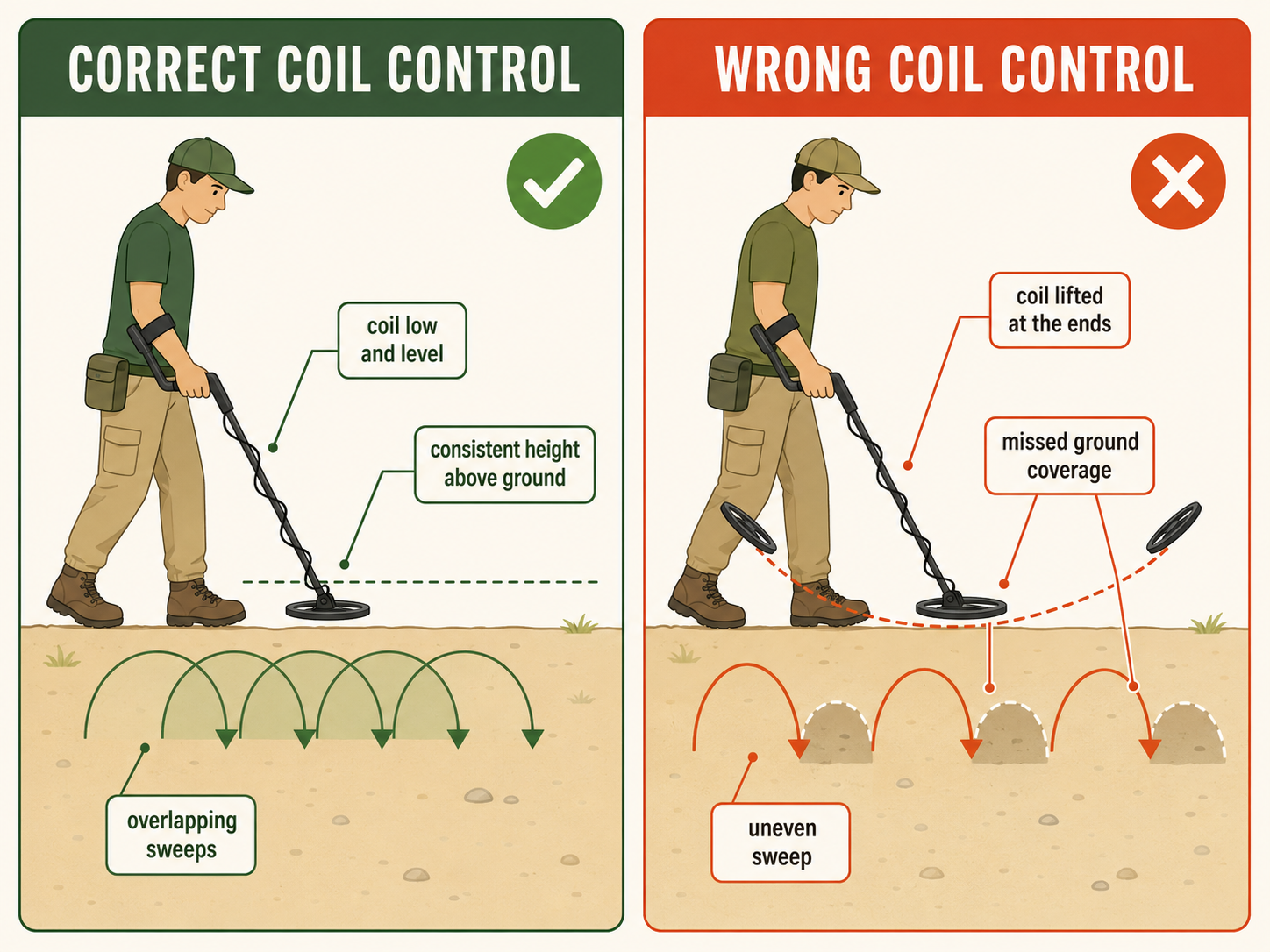
Beginners often swing too fast, lift the coil at the end of each sweep, or hold it too high above the ground. That means missed targets.
The coil should stay low, level and controlled. Not scraping like you are trying to shave the field, but close enough to get the best signal.
Good swing habits
- Keep the coil level through the whole sweep.
- Do not lift the coil at the edges.
- Overlap each swing.
- Slow down in noisy or target-rich areas.
- Search from another direction if a signal is interesting.
If you are swinging like you are late for the bus, slow down.
7. Wearing steel toe cap boots
This one deserves its own section because it is both funny and deeply annoying.
Steel toe cap boots and metal detecting are not good friends.
When you are learning, you may find yourself chasing signals that seem to move, disappear, or appear just as you step closer to the hole. Sometimes the target is not in the ground at all. Sometimes it is on your feet.
Ask me how I know.
Simple fix:
Wear comfortable waterproof boots without steel toe caps. Your feet will thank you, and your detector will stop arguing with your footwear.
8. Digging every hole badly
Good digging matters.
A messy plug, open hole or damaged pasture can ruin a permission faster than almost anything else. Landowners do not want animals injured, machinery damaged or fields left looking like a squad of angry badgers has been through.
A neat plug is a sign of respect. It shows the landowner you care about the land.
Better digging habits
- Pinpoint carefully before digging.
- Cut a neat plug where ground conditions allow.
- Keep loose soil together.
- Recover the target without widening the hole unnecessarily.
- Replace soil and plug properly.
- Press the plug down so it is safe and tidy.
- Do not dig when conditions will cause damage.
If someone can see where you have been from across the field, you are doing it wrong.
9. Leaving rubbish behind
You will dig rubbish. Loads of it.
Ring pulls, foil, can slaw, nails, shotties, moo tubes, rusty bits, tractor parts and all the hedge fodder you could possibly wish for.
The mistake is putting it back in the hole, throwing it in the hedge, or leaving it for someone else.
Take it with you.
Why removing rubbish matters
- It protects livestock and wildlife.
- It keeps the landowner happy.
- It stops you digging the same junk again next time.
- It shows detectorists are responsible.
- It leaves the land better than you found it.
Rubbish in the pouch is annoying. Rubbish back in the ground is worse.
10. Expecting treasure on your first day
Metal detecting is exciting because anything can happen.
But expecting a find of a lifetime on your first outing is setting yourself up for disappointment.
Your first few trips are really about learning. Learning tones, signals, how your detector behaves, how to pinpoint, how to dig, how to recover targets, how to deal with junk and how to stay patient.
You might find something brilliant early on. Some people do. But most beginners find modern coins, rubbish, lead, buttons, shotties and a few mystery items before the really exciting stuff comes along.
The right mindset:
Treat the first few outings as practice. Every target teaches you something, even the rubbish ones. Especially the rubbish ones, sadly.
The good finds feel better when you know how many nonsense signals came before them.
11. Not digging enough signals while learning
This sounds like the opposite of what some people will tell you, but beginners should dig more signals than experienced detectorists.
Why?
Because you need to learn what the detector is telling you.
If you only dig perfect textbook signals, you will miss the messy real-world signals. Coins on edge, masked targets, deep items, odd-shaped finds, mixed-metal objects and targets near iron can all sound less than perfect.
While learning, dig:
- Solid repeatable signals.
- Signals that repeat from more than one direction.
- Odd signals you want to understand.
- Targets with jumpy numbers, just to learn what they are.
- Signals that sound different from the usual rubbish.
You cannot learn signals properly if you never dig them.
12. Trusting target ID numbers too much
Target ID is useful, but it is not magic.
Beginners often see a number on the screen and treat it as gospel. Then they get annoyed when the “coin signal” is foil, or the “rubbish signal” turns out to be something interesting.
Target ID can be affected by depth, soil, angle, target shape, corrosion, nearby iron, mineralisation and how the object is sitting in the ground.
| Beginner assumption | Reality |
|---|---|
| Stable number means coin | It might, but it could also be junk with a nice shape. |
| Jumpy number means rubbish | Not always. Some good targets are awkward. |
| Low number means ignore | Small jewellery, thin hammered coins and odd artefacts can surprise you. |
| Iron grunt means nothing good | Usually rubbish, but iron can mask better nearby targets. |
Listen to the tone, check from different directions, and use the number as one clue, not the whole answer.
13. Ignoring research
You can find things by wandering randomly. It happens.
But research makes the hobby much more interesting and gives you a better starting point.
Old maps, field names, Google Earth, LiDAR, local history and landowner knowledge can all help you understand where people used to walk, work, meet, travel and lose things.
Without research, a big permission can feel like a blank field. With research, it becomes a story.
Simple research habit:
Before your first visit, choose three areas to search: an old path line, a gateway or boundary, and one feature shown on old maps or satellite imagery.
For the full process, read: How To Research Land For Metal Detecting
14. Cleaning finds too much
This one hurts because once the damage is done, it is done.
Beginners often get home, see a muddy coin or object, and immediately start scrubbing, soaking, polishing or attacking it with whatever “cleaning method” they saw online.
That can ruin patina, remove detail, damage surfaces and make identification harder.
A Roman grot, a hammered coin, a copper token, a buckle or a lead seal does not need to look brand new. In many cases, the surface is part of what makes it interesting.
Do this instead:
- Photograph the find before cleaning.
- Record where it came from.
- Remove only loose soil at first.
- Do not use acids, polish or harsh chemicals.
- Ask your FLO if the find may be important.
A slightly dirty find with its surface intact is better than a shiny ruined one. See our full guide on how to clean metal detecting finds.
15. Not recording find spots
A find without a location loses a lot of its story.
Beginners sometimes put everything into one pouch, get home, empty it all on the table, and then realize they have no idea which field anything came from.
That is fine for modern junk. It is not fine for interesting finds.
Record at least:
- Date found.
- Permission or field name.
- Rough GPS or grid reference for interesting finds.
- Depth, if known.
- Photos before cleaning.
- Any nearby finds or features.
Future you will not remember. Future you is overconfident.
16. Not reporting potential Treasure
This is not one to mess around with.
If you find something that may be Treasure, report it properly. Do not sit on it, clean it, sell it, hide it, split it up, or hope nobody notices.
In England and Wales, potential Treasure should be reported to your local Finds Liaison Officer within 14 days of finding it or realising it might be Treasure.
If it might be Treasure:
- Stop digging if there may be more objects.
- Do not clean it.
- Record the exact find spot.
- Tell the landowner.
- Contact your FLO or the correct reporting authority.
Reporting properly protects you, the landowner, the find and the hobby.
17. Posting exact locations online
Asking for help online is fine. Posting exact locations is not.
If you post a find with field names, recognizable landmarks, GPS screenshots, farm details or exact village clues, you may attract unwanted attention to the permission.
That is unfair on the landowner and risky for the site.
Better online wording
“Found in Lincolnshire on pasture” is usually enough for public discussion. You do not need to say which farm, which field, which hedge or which old chapel mound it was next to.
Protect your permissions. Good ones are hard enough to get.
18. Detecting in bad conditions
Sometimes the best decision is not to detect.
If the ground is waterlogged, the crop is wrong, livestock are in the field, the landowner has asked you to wait, or conditions mean you will damage the land, leave it.
A good permission is worth more than one impatient session.
Responsible detectorist rule:
Just because you can go detecting today does not mean you should.
19. Going out unprepared
We have all forgotten something.
Batteries. Headphones. Gloves. Finds pouch. Permission details. Water. Phone battery. Pinpointer. Common sense.
The annoying part is that most of these problems are avoidable with a simple kit check.
Quick pre-detecting checklist
- Detector charged or spare batteries packed.
- Pinpointer charged.
- Headphones packed.
- Digging tool and finds pouch ready.
- Gloves and suitable boots.
- Phone charged.
- Permission details saved.
- Water, snacks and weather-appropriate clothing.
- Small finds bags or boxes for delicate items.
Nothing humbles you quite like arriving at a permission and realising your detector battery is dead. Our beginner kit guide has the full list.
20. Not using headphones
You can detect without headphones, but I would not recommend it.
Headphones help you hear faint signals, subtle tone changes and quieter target responses. They also stop your detector beeping loudly across a field, beach or public space and annoying everyone nearby.
Once you start listening properly, you realize how much information is in the audio.
Beginner tip:
Learn your detector’s tones with headphones on. The screen helps, but your ears will often tell you more.
21. Chasing every “best settings” post online
Online settings can be helpful, but they can also confuse the life out of beginners.
Someone else’s perfect settings may not be perfect for your detector, your ground, your coil, your targets or your experience level.
The best settings are the ones you understand.
Better approach:
- Start with a simple factory preset.
- Make one change at a time.
- Test settings on known targets.
- Keep notes if something works well.
- Do not copy advanced settings before you understand the basics.
A simple setup you understand beats advanced settings you are blindly copying.
22. Giving up too quickly
Some permissions are slow. Some days are quiet. Some fields seem determined to humble you.
That does not always mean the land is bad or the detector is rubbish. Sometimes you are learning. Sometimes you are in the wrong part of the field. Sometimes the ground conditions are poor. Sometimes the finds are just not there that day.
Metal detecting takes patience.
I have had days where all I seemed to find was junk, then one small object made the whole trip worthwhile. I have also had days where the best find was the walk itself. That sounds cheesy, but it is true.
Keep going if:
You are learning your detector, improving your technique, recording your finds, building permission relationships and enjoying the time outside. That is not failure. That is the hobby.
Beginner mistakes at a glance
Here is the quick version to keep in your head.
| Mistake | Why it causes problems | Better habit |
|---|---|---|
| No permission | Illegal or irresponsible detecting damages trust. | Ask first and get it in writing where possible. |
| Sensitivity too high | Creates chatter, false signals and confusion. | Run stable settings you understand. |
| Poor coil control | Misses targets and gives inconsistent signals. | Swing low, level and slow. |
| Messy digging | Damages land and permissions. | Dig neat plugs and refill properly. |
| Leaving rubbish | Bad for land, livestock and the hobby. | Take all junk away. |
| Over-cleaning finds | Can ruin surfaces, patina and identification clues. | Photograph, identify and clean gently, if at all. |
| No recording | Finds lose context and historical value. | Record date, field, location and photos. |
| Expecting treasure | Leads to disappointment and rushing. | Enjoy learning, history and the search itself. |
Summary: the biggest beginner mistake is rushing
Most beginner metal detecting mistakes come from rushing.
Rushing to buy a detector. Rushing to get on land. Rushing over signals. Rushing holes. Rushing to clean finds. Rushing to post online. Rushing to decide something is Treasure, Roman, medieval or rubbish before you actually know.
Slow down.
Get permission properly. Learn your detector. Swing well. Dig neat plugs. Remove rubbish. Record finds. Ask for help. Report anything that may need reporting. And do not expect every outing to change your life.
Metal detecting is the closest thing to a time machine most of us will ever get, but it rewards patience more than panic.
Next beginner guide
New to the hobby? Start with the basics.
If you are still weighing up whether metal detecting is for you, our beginner overview explains what the hobby actually involves and why people love it.
FAQs about beginner metal detecting mistakes
What is the biggest mistake beginner detectorists make?
The biggest mistake is detecting without proper permission. After that, the most common mistakes are poor coil control, running sensitivity too high, digging messy holes, not recording finds and expecting treasure too quickly.
Should beginners dig every signal?
Beginners should dig plenty of signals while learning, but not necessarily every signal forever. Digging a wide range of targets helps you understand your detector, but over time you will learn which signals are worth chasing.
Why is my detector giving false signals?
False signals can come from sensitivity set too high, mineralized ground, wet sand, electrical interference, loose coil cables, poor ground balance or swinging over metal on your clothing or boots.
Are steel toe cap boots bad for metal detecting?
Yes, they can cause annoying signals because the detector can pick up the metal in your boots. Wear comfortable waterproof boots without steel toe caps instead.
Why should I take rubbish away when detecting?
Removing rubbish protects livestock, wildlife and land. It also keeps landowners happy and stops you digging the same junk again next time.
Should I clean finds as soon as I get home?
Not heavily. Photograph and record the find first. Only remove loose soil at first, especially if the item may be old, fragile or important.
Is target ID always accurate?
No. Target ID is a useful clue, but it can be affected by depth, soil, corrosion, target angle, mineralization and nearby iron. Use it alongside tone and signal behaviour.
How can beginners get better at metal detecting?
Learn your detector, practice in a garden test bed, get proper permission, dig neatly, record finds, research your land, ask experienced detectorists for help and be patient. The good finds come with time.
Sources and further reading
These links support the guidance above and provide further reading. Check country-specific rules where noted.
- NCMD Code of Conduct: Permission, protected sites, neat holes, rubbish and responsible reporting.
- NCMD Beginners Guide: Beginner rules, written agreements, landowner rights and safe digging.
- GOV.UK: Report treasure, wreck material or archaeological finds: The official reporting process and 14-day requirement in England and Wales.
- Historic England: Section 42 Consent: Official guidance on metal detecting consent for scheduled monuments in England.
- British Museum: Treasure and the Portable Antiquities Scheme: Background on the PAS, Finds Liaison Officers and the England and Wales scope.