The quick answer
To get permission to metal detect, you need to identify the correct landowner or tenant, ask politely, explain that you are insured and responsible, make it clear you will respect the land, agree what happens with finds, and preferably put the permission in writing before you detect.
The permission rule:
All land belongs to someone. You need permission before detecting, even on places that feel public, such as footpaths, woods, commons, parks and open spaces.
Metal detecting permissions
How To Get Permission To Metal Detect
A practical guide to asking landowners, approaching farmers, improving your chances of getting a yes, and using simple permission letter and agreement templates.
Quick note before we start:
This guide is for general information only and is not legal advice. Permission rules, land ownership, tenancy arrangements and finds agreements can vary. For the full legal background, read my UK Metal Detecting Laws & Code Of Conduct guide, and use official forms or independent legal advice where needed.
This guide covers how to ask for permission, what to say, what not to say, how to handle objections, what to agree before detecting, and includes both a permission letter template and a simple written agreement template you can adapt.
Why permission matters so much
Metal detecting is not just walking. You are searching the land, digging into it and potentially removing objects from it.
That is why permission matters. A public footpath gives people the right to walk along it, not the right to detect and dig. A park being open to the public does not automatically mean you can metal detect there. A field looking empty does not mean nobody owns it.
Permission protects you, the landowner, the finds, the land and the reputation of the hobby. Without it, you are not metal detecting responsibly. You are just giving decent detectorists a harder job when they ask properly.
Good permission should answer:
- Who has given you permission?
- Which land or fields are included?
- When are you allowed to detect?
- Can you bring anyone else?
- Where should you park?
- What happens with finds?
- What happens if something valuable or legally reportable is found?
- Are there any protected areas, crops, livestock or restrictions?
A vague “yeah, should be fine” is better than nothing, but clear written permission is much better.
Why do landowners say no?
Before asking for permission, it helps to understand why landowners might be cautious.
From your side, you are thinking about history, finds and a peaceful day out. From their side, they may be thinking about damaged crops, open gates, livestock escaping, holes left in fields, insurance, strangers turning up whenever they like, arguments over valuable finds and people inviting their mates without asking.
If they have had a bad experience before, you are already starting on the back foot.
| Landowner concern | What they may be worried about | How you can reassure them |
|---|---|---|
| Holes and mess | Damaged pasture, unsafe ground or ugly plugs. | Explain that you dig neat plugs, backfill properly and leave no trace. |
| Livestock | Open gates, disturbed animals or injury risk. | Ask which fields to avoid and follow gate instructions exactly. |
| Crops | Damage to standing crops or tramlines. | Only detect agreed fields at agreed times. |
| Insurance | Damage, injury or liability. | Show public liability insurance or membership details. |
| Valuable finds | Arguments over ownership or money. | Use a written agreement before detecting. |
| Too many people | You bring friends or share the location. | Make it clear permission is for you only unless otherwise agreed. |
Your job is not to pressure them into saying yes. Your job is to show them that you are the kind of person who can be trusted on their land.
Before you ask: get yourself ready
Do not rush straight into asking every farmer within ten miles if you have not got your side organised.
If someone says yes, you want to look like you know what you are doing. You do not need to be an expert, but you should at least understand permission, insurance, digging responsibly and what to do with finds.
Get these sorted first:
- Public liability insurance or detecting membership that includes it, such as the NCMD.
- A basic understanding of the Treasure Act and reporting finds.
- A copy of your membership or insurance proof on your phone (see our beginner kit guide).
- A simple permission letter or card with your contact details.
- A willingness to use a written agreement.
- A neat digging method that leaves no mess.
- A finds pouch so you remove rubbish and keep finds safe.
- A clear idea of whether permission is for you only or includes anyone else.
It also helps if you can show a few harmless finds or photos of finds you have made elsewhere. Not to show off, but to make the hobby feel more real and interesting to the landowner.
Do not take anything valuable or legally sensitive to a stranger’s door. Just a few common coins, buttons, buckles or cleaned-up bits that show you are interested in history rather than just looking for treasure.
Who do you actually need permission from?
This is where it can get a little messy.
You need permission from the person who has the legal right to give it. That might be the landowner, an estate manager, a council, a tenant farmer, a farm manager, a trust, a company or another managing body.
On farmland, the farmer you speak to may own the land outright, or they may rent it. If the farm is tenanted, you may need permission from both the landowner and the tenant farmer, because one may own the land and the other may control day-to-day use.
Plain English version:
Do not assume the first person you ask has the full authority to say yes. If they rent, manage or work the land, politely ask if anyone else needs to approve it.
This does not mean you need to turn into a legal investigator before asking anyone. But it does mean you should be clear. A simple question like, “Are you the person who can give permission for detecting, or would I need to speak to someone else as well?” can save problems later.
The best ways to ask for metal detecting permission
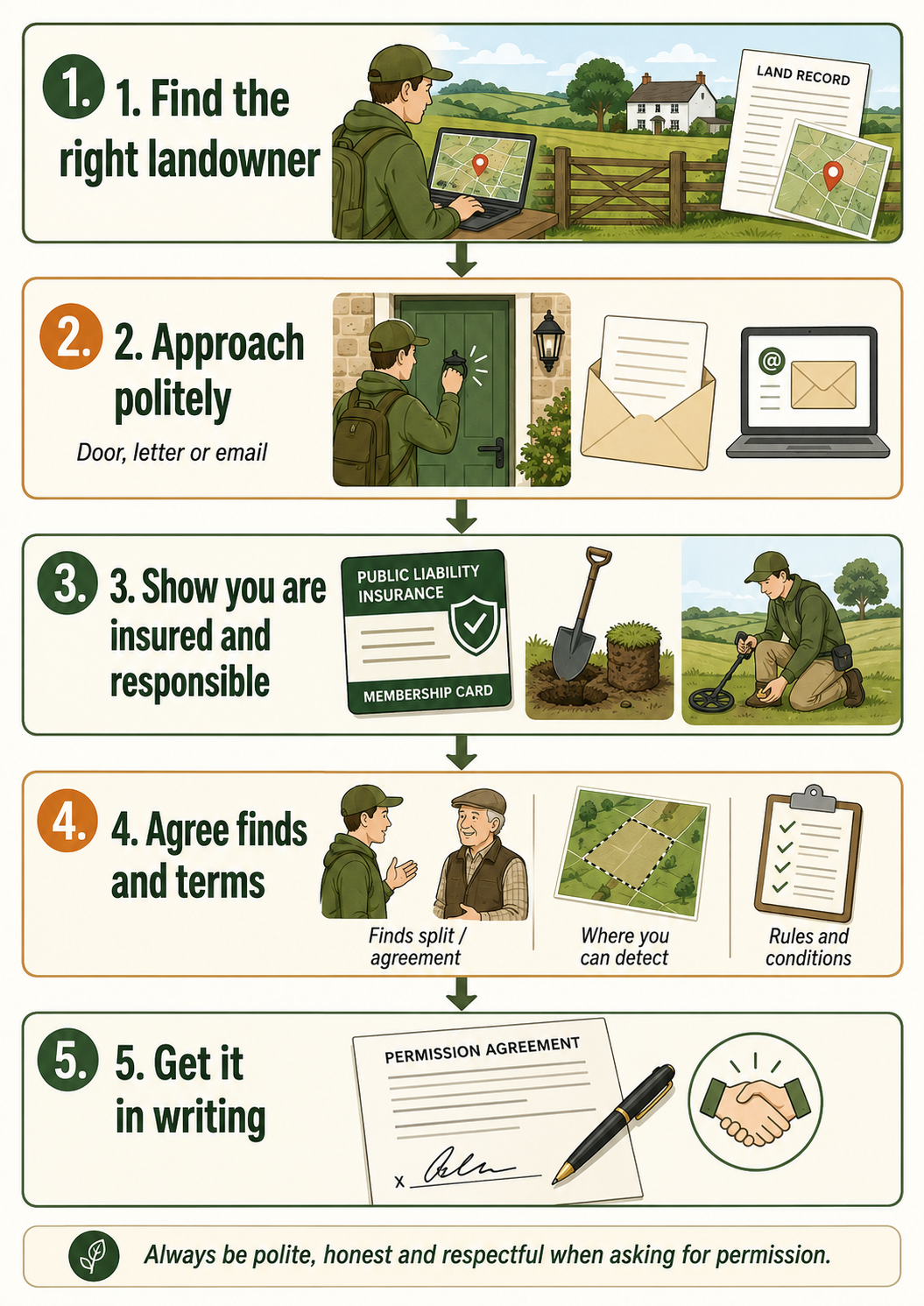
There are a few different ways to ask. None of them are perfect. The best method depends on your confidence, the local area and whether you already have some sort of connection.
| Method | Best for | Pros | Cons |
|---|---|---|---|
| Door knocking | Confident people and local farms. | Personal, direct and harder to ignore. | Can feel awkward and you may catch them at a bad time. |
| Letter | People who are nervous asking face to face. | Polite, low pressure and gives them time to think. | Easy to ignore and response rates can be poor. |
| Phone call | When you have a farm number or known contact. | Quick and direct. | You may interrupt them when they are busy. |
| Email or message | Estates, farms with websites, local contacts. | Easy to include details and proof of insurance. | Can look like spam if written badly. |
| Warm introduction | Local communities and people you already know. | Trust is already partly there. | Takes time to build naturally. |
Door knocking for permission
Door knocking is probably the most effective method, but it is also the one most beginners dread.
I get it. Nobody loves turning up at a farm and asking a stranger for permission. You do not know whether they will be friendly, busy, suspicious or ready to tell you to clear off before you have even finished your sentence.
But door knocking gives you something letters and emails do not: a human conversation.
A simple door-knocking script
“Hi, sorry to bother you. My name is [your name]. I live locally and I’m a responsible metal detectorist. I just wanted to ask whether you ever allow anyone to detect on your land.”
“I’m insured, I follow the code of conduct, I always fill holes properly, remove rubbish, and I’d be happy to show you any finds. I would never turn up without agreeing it with you first.”
“If now is a bad time, I can leave my details with you and you can have a think about it.”
Keep it short. Do not waffle for ten minutes. Farmers and landowners are often busy. If they seem rushed, leave your details and go.
If they say no, accept it politely. Do not argue. Do not try to prove them wrong. Do not say “but it is only a field”. That field may be their livelihood.
A polite no today might become a yes later. A pushy no becomes a never.
Asking by letter
Letters are useful if you are nervous, if the landowner is hard to catch, or if you want to explain yourself properly without putting someone on the spot.
The downside is that letters are easy to ignore. You may send ten and hear nothing back. That is not always because the letter is bad. People are busy, letters get put aside, and some landowners simply are not interested.
Still, a well-written letter can work, especially if it feels personal and respectful rather than copied and blasted out to every farm in the county.
Letter tip:
Include your phone number, email address and location. If you can, include a stamped addressed envelope, although most people will reply by phone or email these days.
Your letter should be polite, short enough to read, and clear about why you are asking. Do not make it sound like you are hunting for treasure or expecting the land to make you rich.
Asking by email or message
Email can work, especially for estates, farms with websites, land agents, councils, businesses and organisations.
The main risk is that your message sounds like spam. If the first line looks generic, it may be deleted before they even understand what you are asking.
Keep it local, polite and specific.
A simple email structure
- Say who you are and where you are based.
- Explain that you are a responsible detectorist.
- Ask whether they ever allow detecting on their land.
- Mention insurance and code of conduct.
- Explain how you treat land, holes, rubbish and finds.
- Offer to meet or discuss it properly.
- Thank them and leave your contact details.
Do not attach five documents and a life story to the first email. You can offer to send insurance proof or a sample agreement if they are open to discussing it.
What should you say when asking?
The best permission requests are simple, respectful and focused on trust.
You want the landowner to understand that you are not going to damage the land, cause hassle, turn up unannounced, bring a crowd, hide finds or create problems.
Say you are insured
Public liability insurance shows you are serious and gives the landowner a bit more confidence.
Say you follow the code
Explain that you fill holes, remove rubbish, respect livestock and report important finds properly through the Portable Antiquities Scheme.
Offer to show finds
Many landowners appreciate being kept in the loop, even if they are not especially interested at first.
Make access clear
Promise that you will only attend agreed areas at agreed times and will not bring anyone else unless agreed.
A good one-liner
“I’m not asking to come and help myself to your land. I’m asking whether you would consider allowing me to detect responsibly, by agreement, and on your terms.”
What not to say when asking for permission
Sometimes detectorists shoot themselves in the foot before the landowner has even had chance to think.
Avoid anything that makes you sound greedy, careless, entitled or hard work.
Avoid saying things like:
- “There could be treasure on your land.”
- “Nobody will know I have been there.”
- “I only dig small holes.”
- “Other farmers let me.”
- “It is only a field.”
- “Can I bring a few mates?”
- “I will split anything valuable with you” before you have discussed legal reporting properly.
- “I saw an old map and I think your land has Roman stuff on it.”
That last one might sound tempting, especially if you have done research, but be careful. Telling a landowner their land might be archaeologically sensitive can make them nervous, not excited.
Lead with responsibility and respect, not treasure hunting.
How to handle common objections
If a landowner hesitates, that does not always mean no. Sometimes they just need reassurance. Other times, it is a no and you need to accept it.
| They say… | What they may mean | How you could reply |
|---|---|---|
| “I do not want holes everywhere.” | They are worried about mess or unsafe ground. | “I completely understand. I cut neat plugs, refill everything properly and you are welcome to check after my first visit.” |
| “What if you find something valuable?” | They want fairness and clarity. | “We can agree that in writing before I detect, and anything that may be Treasure would be reported properly.” |
| “I have livestock.” | They are worried about gates, animals and disturbance. | “I can avoid any fields with livestock and only go where you say is suitable.” |
| “Someone already detects here.” | They may already have an arrangement. | “No problem at all. If anything changes, I’d be grateful if you kept my details.” |
| “I will have to think about it.” | They are not ready to decide. | “Of course. I’ll leave my details with you, and there is no pressure.” |
What to do when they say yes
When someone says yes, do not get so excited that you forget the important bits.
A yes is the start of the arrangement, not the end of it. You need to clarify exactly what has been agreed.
Before your first visit, agree:
- Which fields or areas you can detect.
- Which areas are off limits.
- Where you should park.
- Whether you need to call or message before each visit.
- Whether you can bring anyone else.
- What happens with normal finds.
- What happens with valuable finds.
- What happens if something may be Treasure.
- Whether there are livestock, crops, shooting days, work areas or access issues to avoid.
If they are happy to sign a simple agreement, brilliant. If not, at least confirm the basics by text or email.
For example: “Thanks again for allowing me to detect the two stubble fields behind the yard. I’ll message before visiting, park by the old barn as agreed, and show you any finds after each visit.”
Free template
Metal detecting permission letter template
Use this as a starting point. Do not just copy it word for word if it sounds nothing like you. Make it natural, local and personal.
Template letter:
Dear [Landowner/Farmer’s Name],
My name is [Your Name], and I live in [Your Area]. I am writing to ask whether you would consider giving me permission to metal detect on your land.
I am a responsible detectorist and take the hobby seriously. I have public liability insurance through [NCMD/FID/Other Membership or Insurance Provider], and I follow the metal detecting code of conduct at all times.
If permission were granted, I would only detect on the areas you agree to, at times suitable for you. I would never turn up unannounced, never bring anyone else without your permission, and would always respect crops, livestock, gates, tracks and any areas you wanted me to avoid.
I always dig carefully, refill any holes properly and remove any rubbish I find, including sharp scrap or items that could cause harm to livestock or machinery.
I would also be happy to show you any finds made on your land. If anything unusual, valuable or potentially classed as Treasure were found, I would follow the proper reporting process and discuss it with you straight away.
I understand you may be busy, so there is no pressure. If this is something you would be willing to discuss, I would be happy to speak by phone, email or in person at a time convenient for you.
Thank you for taking the time to read this letter.
Kind regards,
[Your Name]
[Your Phone Number]
[Your Email Address]
[Membership/Insurance Details, if applicable]
Make it better:
Add one or two personal details if genuine. For example, mention that you live locally, are interested in the history of the area, or would be happy to help recover lost metal items if they ever lose keys, tools or machinery parts.
Free template
Short email or message template
If you are asking by email or social media message, keep it shorter than a letter. You can always send more detail later if they reply.
Hi [Name],
My name is [Your Name], and I live locally in [Area]. I wanted to ask whether you ever allow responsible metal detecting on your land.
I am insured, follow the metal detecting code of conduct, always fill holes properly, remove rubbish, and would only detect on agreed areas at agreed times.
I would also be happy to show you any finds and agree everything clearly beforehand, including what happens if anything unusual or valuable is found.
No pressure at all, but if this is something you would consider, I would be grateful for the chance to discuss it.
Kind regards,
[Your Name]
[Phone Number]
Free template
Metal detecting permission agreement template
A written agreement helps avoid awkward conversations later. It does not need to be scary or overcomplicated, but it should make the basics clear.
For higher-value arrangements, estates, commercial land, complex tenancy situations or anything legally sensitive, use an official search agreement or get proper advice. The template below is a simple starting point for ordinary private permission discussions.
Simple permission agreement:
Metal Detecting Permission Agreement
This agreement is made between:
Landowner/Occupier: ____________________________________________
Address or land description: _____________________________________
Detectorist: _________________________________________________
Detectorist contact details: ____________________________________
The landowner/occupier gives permission for the detectorist named above to use a metal detector on the agreed land or areas described below:
Agreed detecting areas:
______________________________________________________________________
______________________________________________________________________
Areas excluded or off limits:
______________________________________________________________________
______________________________________________________________________
Permission start date: ___________________________
Permission end date, review date or ongoing arrangement: ___________________________
Detectorist responsibilities
The detectorist agrees to:
- Only detect on the agreed areas.
- Contact the landowner/occupier before visiting if required.
- Not bring any other detectorists or guests without permission.
- Park only where agreed.
- Respect crops, livestock, fences, gates, tracks and farm operations.
- Fill all holes properly and leave the land safe and tidy.
- Remove rubbish and sharp scrap recovered while detecting.
- Report unusual or potentially important finds to the landowner/occupier.
- Follow the metal detecting code of conduct.
- Follow all legal requirements relating to Treasure, protected sites and archaeological finds.
- Stop detecting immediately if asked to do so by the landowner/occupier.
Insurance
The detectorist confirms that they hold public liability insurance or membership that includes appropriate cover.
Insurance or membership provider: ________________________________
Membership or policy number, if applicable: _________________________
Finds agreement
The parties agree that ordinary finds will be dealt with as follows:
______________________________________________________________________
______________________________________________________________________
If an item of significant financial value is found, the parties agree that it will be dealt with as follows:
______________________________________________________________________
______________________________________________________________________
If any find may qualify as Treasure, the detectorist and landowner/occupier agree that it must be reported through the proper legal process and not sold, cleaned heavily or removed from that process.
Protected areas and restrictions
The landowner/occupier has informed the detectorist of any known protected sites, scheduled areas, SSSIs, environmental restrictions, livestock areas, crop restrictions or other limitations affecting the land.
Known restrictions:
______________________________________________________________________
______________________________________________________________________
Signatures
Signed by the landowner/occupier:
Signature: _______________________________ Date: ______________________
Printed name: ________________________________________________________
Signed by the detectorist:
Signature: _______________________________ Date: ______________________
Printed name: ________________________________________________________
Important:
This simple template is not a replacement for an official agreement or legal advice. For anything involving valuable finds, estates, tenancy complications, archaeological sensitivity or commercial arrangements, use proper advice and official documentation.
What should you agree about finds?
Finds can cause awkwardness if nobody has discussed them beforehand.
Most of the time, you will be dealing with ordinary finds: bits of lead, buttons, buckles, coins, scrap, farm items and the occasional mystery object. But if something valuable or historically important turns up, everyone needs to know what happens next.
Things to agree before detecting:
- Can the detectorist keep ordinary low-value finds?
- Does the landowner want to see all finds?
- Will interesting finds be photographed and shared?
- What happens if a valuable non-Treasure item is found?
- What happens if a find may be Treasure?
- How would any reward or sale proceeds be split?
- Who stores a find while advice or valuation is being sought?
The usual informal arrangement many detectorists work with is to show the landowner finds and split anything of significant value fairly, often 50/50. But do not assume that. Agree it clearly.
Remember, if something may be Treasure, it must go through the proper reporting process. A private agreement cannot override the law.
Read more here: What To Do If You Find Treasure Metal Detecting
How to keep a metal detecting permission
Getting permission is hard. Keeping it is where you prove yourself.
A lot of detectorists focus so much on getting a yes that they forget the relationship afterwards. If a landowner trusts you, treat that trust like gold. Better than gold, actually, because permission is what gives you the chance to find anything in the first place.
Message before visiting
Even if they say you can come anytime, a quick message keeps things respectful.
Show finds
It builds trust and keeps the landowner involved, even if they only have mild interest.
Remove rubbish
Taking sharp scrap away is one of the easiest ways to show you are useful, not a nuisance.
Do not invite others
Permission for you does not mean permission for your mate, your cousin and three people from Facebook.
Respect working land
Crops, livestock, shooting days, machinery and farm work all come before your hobby.
Say thank you
A thank you message, Christmas card or small gesture can go a long way.
What if they say no?
They will. Not everyone, but plenty.
Do not take it personally. Landowners have their own reasons, and they do not owe you access to their land. A no is not an insult. It is just a no.
How you handle a no matters.
Best response:
“No problem at all, thank you for taking the time to speak to me. If you ever change your mind, I’ll leave my details with you.”
That is it. No arguing. No sulking. No “but I’m insured”. No trying to convince them for another five minutes while they are clearly done with the conversation.
You never know what happens later. They might change their mind. They might mention you to another farmer. They might respect the fact you handled it politely.
Reputation travels in rural areas. Make sure yours is good.
Where should beginners look for their first permission?
If you are brand new, start with warmer leads before cold approaching every farm you can see on a map.
People are more likely to trust you if there is already some kind of connection.
Good places to start:
- Family and friends with gardens or land.
- People you know through work, pubs, clubs or hobbies.
- Local farmers you already speak to.
- Smallholdings and paddocks where permission may be simpler.
- Older properties where the owner is interested in local history.
- Club digs where you can build experience and confidence.
- Landowners who have lost keys, jewellery or tools and may need help finding them.
Do not underestimate small permissions. A garden, paddock or small field might teach you more than a massive permission where you have no idea where to start.
Once you have experience, finds photos, insurance, confidence and a good track record, asking for bigger permissions becomes easier.
Summary: how to get permission to metal detect
Getting permission is not easy, but it is not impossible either.
The key is to approach landowners respectfully, understand their concerns, show that you are insured and responsible, agree everything clearly, and protect the relationship once permission is granted.
Do not make the conversation about treasure. Make it about trust.
Be polite. Be patient. Be clear. Accept no properly. Treat a yes like a privilege, not a right. Fill your holes, remove rubbish, report finds properly and never give the landowner a reason to regret saying yes.
Do that, and over time you will give yourself the best chance of building good permissions and enjoying the hobby properly.
Next beginner guide
Got permission? Research the land before you go.
Once you have permission, a bit of research can help you find old paths, vanished buildings, gathering spots and areas with better potential.
FAQs about metal detecting permission
Do I need permission to metal detect on private land?
Yes. You need permission from the landowner or the person with authority to grant access. If the land is tenanted, you may need permission from both the landowner and the tenant farmer.
Is verbal permission enough?
Verbal permission is better than no permission, but written permission is much safer. A text, email or signed agreement helps avoid confusion later.
Should I offer to split finds with the landowner?
It is sensible to agree what happens with valuable finds before detecting. Many detectorists agree a fair split with the landowner, but anything that may be Treasure must be reported properly and cannot simply be privately sold.
What should I take when asking for permission?
Take your contact details, proof of insurance or membership, a simple permission letter, and perhaps a few photos of ordinary finds. Do not overwhelm the landowner with paperwork unless they are interested.
Is door knocking better than sending letters?
Door knocking is often more effective because it creates a real conversation, but it takes confidence and timing. Letters and emails can still work, especially if they are personal and respectful.
Can I bring a friend if I get permission?
Not unless the landowner agrees. Permission for you does not automatically include other people.
What if the landowner says no?
Accept it politely and leave your details if appropriate. Do not argue or pressure them. A respectful no may still leave the door open for the future.
Do I need insurance to get permission?
Insurance is not the same as permission, but it helps reassure landowners and shows you take the hobby seriously. Many detectorists use membership organisations that include public liability cover.
Sources and further reading
These links support the guidance above and provide further reading. Check country-specific rules where noted.
- NCMD Code of Conduct: Primary hobby guidance on permission, responsible digging, protected sites and reporting.
- NCMD Beginners Guide: Confirms landowner and tenant permission, written agreements and different national rules.
- NCMD Permission Agreement: A ready-made agreement form for clarifying permission terms.
- GOV.UK: Report treasure, wreck material or archaeological finds: Official guidance on permission, reporting and country differences.
- Historic England: Section 42 Consent: Confirms that landowner permission does not replace scheduled-monument consent in England.