
Garrett AT Pro Review
Our Full Review
Let me be straight before we start
I have owned a fair few Garretts over the years, the Ace 150, the 250 and the Euro Ace, but the AT Pro was never one of mine. So this is not a first-hand review. It is a summary of the wider community’s experience, pulled from years of forum threads, long-term owner write-ups and manuals, specifications and owner reports, with the marketing stripped out.
The workhorse that earned its reputation
The AT Pro arrived in 2011 and quickly became one of the most owned serious detectors going. AT stands for All Terrain, and that is the whole pitch: a tough, single-frequency 15kHz machine that is waterproof and submersible to ten feet, so it goes from a ploughed field to a freshwater river without a second thought. More than a decade on, people are still buying them, and that staying power tells you most of what you need to know.
What owners genuinely rave about
Two words come up before any others: reliable and tough. You read account after account of AT Pros run almost daily for years with nothing breaking except the cheap stock headphones. For a piece of kit that gets dragged through mud, rain and rivers, that reputation for simply not dying is a big part of why owners love it. The waterproofing is the real thing too, not a splash rating, and being properly submersible opens up freshwater rivers and lake edges that would quietly kill a lot of machines.
On performance the praise is consistent. The consensus appears to be that it is the deepest Garrett a lot of owners have used in disc mode, with a fast recovery speed and a target ID that holds up even at depth. Why does recovery speed matter? It is how quickly the detector resets after one target so it can hear the next, and a fast machine keeps two close targets as two separate signals instead of smearing them into one ugly grunt. That feeds straight into the AT Pro’s other real strength, iron. Owners say again and again that it lets them lift a good target out from right beside junk, which is exactly what saves finds on an old site carpeted in nails.
Then there is the Pro audio, which is the real heart of the machine. In Pro mode the AT Pro gives you proportional, modulated audio instead of simple on-off beeps, so the sound itself carries information, the target’s size, its depth, how it is sitting in the ground. Long-term users describe more or less reading the ground by ear once it clicks. That richness is the thing experienced owners would not hand back.
The gripes that come up again and again
That same Pro audio is also the machine’s biggest hurdle. The modulated sound is genuinely off-putting at first, and plenty of beginners drop back to Standard mode, or bounce off the detector entirely, before it has had chance to make sense. This is not a switch-on-and-master-it machine. It rewards the time you put in and frustrates anyone expecting instant results.
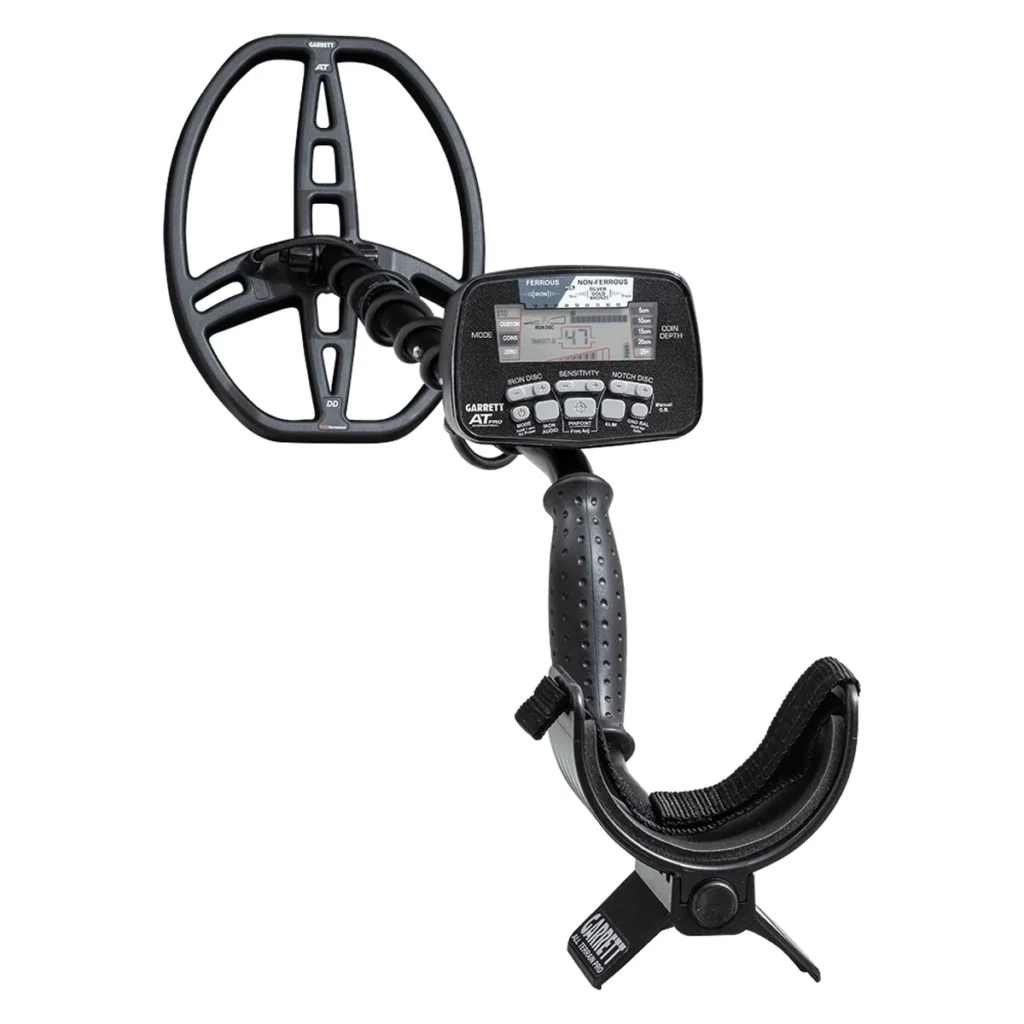
The screen is the next recurring complaint, and it is a fair one. It washes out in bright sun and through polarised sunglasses, and there is no backlight at all, so in low light or after dusk you are detecting blind to the display. The other well-worn niggle is the connectors. The coil lead and headphone lead seat into the control box awkwardly, and owners warn you have to get them in exactly right or you risk damaging them. The stock headphones, meanwhile, are widely treated as the first thing to bin.
The honest big one for our kind of detecting is the salt beach. The AT Pro is single-frequency, and on wet salt sand single-frequency machines false and struggle. On inland fields and in freshwater it is in its element, but if your detecting is mostly on salt beaches this is simply the wrong tool, and the community is unanimous on that. It is also worth knowing the very earliest units had a false-signal issue that Garrett recalled and sorted, so a later or fixed machine is what you want.
If I were buying one, here is what I would actually do
Commit to learning Pro mode, because the whole value of the AT Pro lives in that audio and treating it as a simple two-tone machine wastes most of what you paid for. Budget for a decent set of headphones from day one, since the stock pair is the weakest part of the package. And if you hunt heavy trash, add a smaller sniper coil: the stock DD does the job but rings a wide patch of ground in rubbish, which makes pinpointing and digging neat holes harder than it needs to be.
Buying one used
Used AT Pros are plentiful and often a genuine bargain, which is arguably the best reason to own one now. Before you pay, look closely at those awkward coil and headphone sockets and plugs for any damage, check the screen is clear, and if the machine has obviously seen water use, satisfy yourself the seals are still intact. Given that early false-signal recall, it is also worth confirming you are looking at a later or corrected unit rather than a first-run machine that slipped through.
Who I would point towards it, and who I would steer away
I would happily put an inland coin and relic hunter, or anyone who wants one tough, dependable, waterproof machine for fields and freshwater, onto an AT Pro, as long as they are willing to learn the Pro audio. It is a brilliant do-it-all workhorse for that detectorist, especially bought used. I would steer away anyone who mainly hunts salt beaches, anyone who wants plug-and-play simplicity with no learning curve, and anyone chasing the very best modern target separation, because multi-frequency machines have moved the game on in those areas.
How it stacks up in 2026
The obvious question is whether to spend up on the newer Garrett AT Max instead. The Max is the natural successor: it adds wireless audio, a backlit screen, improved ground balance and a touch more depth, while staying single-frequency at heart. So it fixes two of the AT Pro’s real annoyances, the screen and the headphone faff, without reinventing the machine. If those niggles bother you and you are buying anyway, the Max is the logical pick, but it is a refinement rather than a revolution.
The bigger shift is multi-frequency. A used Minelab Equinox 600 or 800 will generally beat the AT Pro on the salt beach and on outright separation in really mineralised or trashy ground, and for a lot of detectorists that is a more meaningful upgrade than going Pro to Max. None of that erases the AT Pro. It just means its best case now is a rugged, deep, bargain inland and freshwater machine, rather than the one-detector-does-everything champion it once was.
Community Verdict
After reading years of owner opinion, the picture is steady and honest. The AT Pro is a tough, reliable, genuinely deep workhorse whose Pro audio rewards the detectorist willing to learn it, and whose build quality and true waterproofing have kept it in daily use long after newer machines arrived.
Has it aged well? On inland and freshwater ground, very. Is it overshadowed? On the salt beach and on outright separation, yes, by multi-frequency rivals like the Equinox. Is it better bought used than new? Almost certainly, given how cheap and plentiful they are now. The most telling thing is how many long-term owners still rate theirs and keep swinging it, niggly screen, fiddly plugs and all. For the right detectorist, on the right ground, it remains a lot of dependable machine for the money.
Remember, this is me handing on the collected wisdom of people who have actually put the years in, not my own field notes. If you have run an AT Pro yourself and reckon I have got something wrong, drop me a line through the contact page. The site is always better for being corrected.
How It Performs
- ✓Fully submersible to 3m
- ✓Dual ground balance (auto & manual)
- ✓15 kHz suits coins, relics and some gold
- ✓Proven reliability
- ✓Huge accessory and coil ecosystem
- ✗Showing its age vs modern multi-frequency detectors
- ✗Single frequency
- ✗Analog-feel controls
An excellent all-round detector that punches well above its price. Best suited to intermediate-level detectorists focused on coins, relics, beach, all-purpose.
Last reviewed: 2026-05-24
Affiliate disclosure: we may earn a commission at no extra cost to you. Our reviews stay independent.
Garrett AT Pro: Owner's Reference and Setup
The practical detail behind the review: the coils that fit, the accessories worth knowing about, sensible starting settings and the questions that come up most. Checked against Garrett's own listings and years of owner discussion.
Best accessories for the Garrett AT Pro
- Waterproof headphones The one that matters. The AT Pro is submersible, but normal land headphones are not, so you need Garrett-compatible waterproof headphones for submerged work.
- Z-Lynk wireless kit Garrett's own wireless audio system, a popular way to cut the headphone cable on a machine that is otherwise wired.
- Search coils and covers Garrett's own Pro-Pointer is the usual pairing, though any pinpointer helps.
- A pinpointer and digging tool Garrett's own Pro-Pointer is the usual pairing, though any pinpointer helps.
Coils that fit the Garrett AT Pro
| Coil | Type | Best for |
|---|---|---|
| Stock DD | 8.5 x 11 in DD | General all-round use |
| Small sniper DD | Compact DD | Iron-littered trashy ground and tight pinpointing |
| Larger coil | 12 to 13 in class DD | Coverage and depth on cleaner pasture or beach |
The AT Pro ships with an 8.5 x 11 inch DD coil and the AT platform is well served for coils from Garrett and the aftermarket (NEL, Detech, Mars). Confirm a coil is listed for the AT Pro or the AT family before buying.
Headphones and audio for the Garrett AT Pro
The control box has a 6.35 mm headphone socket under a waterproof cover. For land use any wired headphones are fine, but for water use you must switch to Garrett-compatible waterproof headphones. Z-Lynk is the wireless alternative on dry land.
Best settings for the Garrett AT Pro
- If you are new, learn in Standard mode first, then move up to Pro mode for the fuller, more informative audio.
- Ground balance at every site, manually where the soil changes across a field.
- For relics, many owners run Pro Zero (all-metal Pro audio) with the iron discrimination tuned to the site.
- Wind sensitivity back in heavy iron or on wet salt, where running it hot just causes falsing.
Firmware and manuals for the Garrett AT Pro
There is no user-installable firmware for the AT Pro. Treat it as a fixed control box, which is one less thing to worry about when buying used.
Garrett publish the AT Pro manual through their support area. It is worth a read for the Pro Audio and Standard Audio behaviour, ground balance and waterproof-care instructions.
View the manualGarrett AT Pro: common questions
Is the AT Pro waterproof?
Yes, it is submersible to 3 metres (about ten feet), so freshwater rivers and lake edges are well within its remit. Use waterproof headphones for submerged work.
Is the AT Pro a good beginner machine?
It can work for a serious beginner, but the audio and settings are more involved than the simpler ACE line, so expect a learning curve.
Is the AT Pro still worth buying?
For rugged single-frequency all-terrain use, yes. If wet-salt beach performance matters, weigh it against the Garrett Apex and modern multi-frequency machines first.
More detectors and guides
Compare it head to head in Garrett AT Pro vs Minelab Equinox 800 and Garrett AT Pro vs Garrett AT Max. Or browse other Garrett machines like Garrett Apex, Garrett ACE 400 and Garrett ACE 300. Read the Garrett range in full, or open the detecting glossary for plain-English explanations of multi-frequency, discrimination and pinpointing.