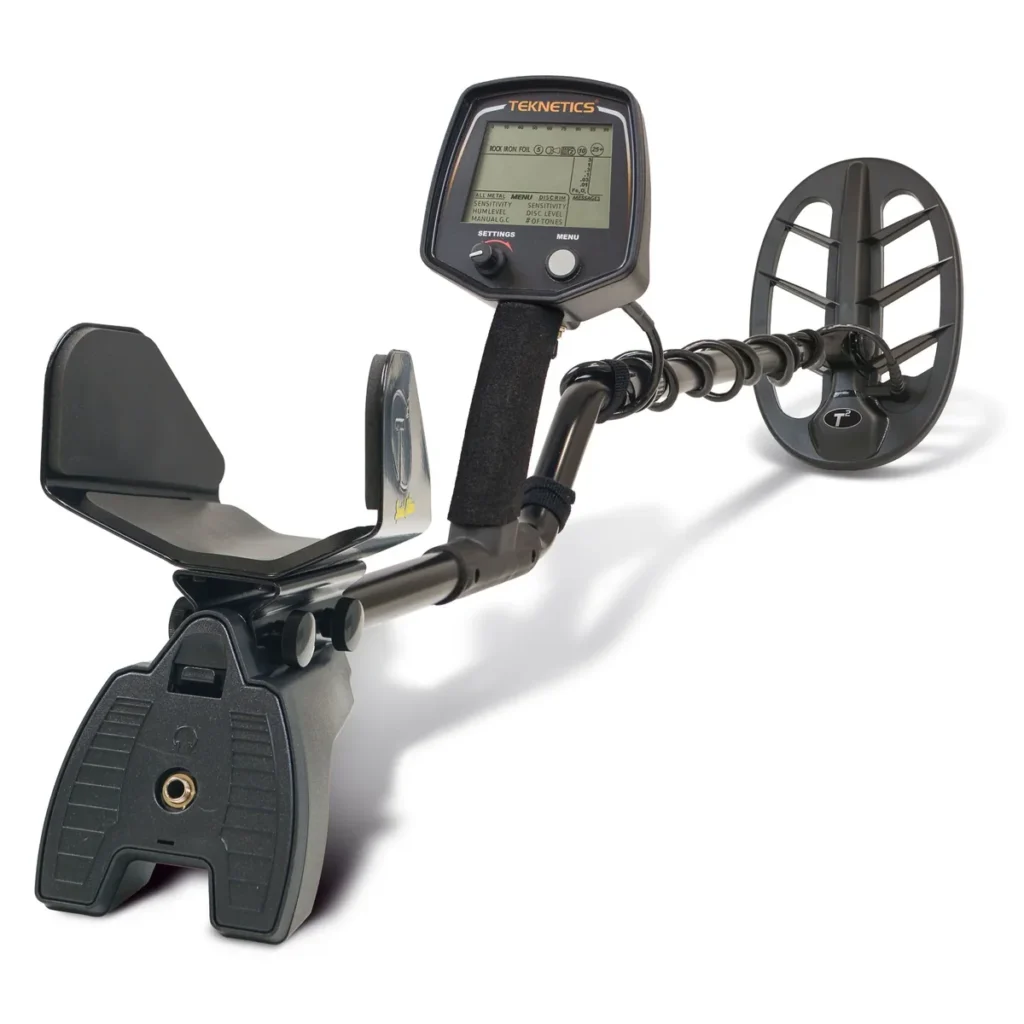
Teknetics T2 Review
Our Full Review
Where this comes from: a research-based review. I have not owned or used a Teknetics T2 myself. What follows comes from years of relic-hunting forums, long-term owner reviews and manuals, specifications and owner reports. The T2 has a devoted following and one very well-known flaw, so I have tried to give you both honestly.
The relic hunter’s depth machine
The T2 is a single-frequency VLF detector from First Texas, designed by the legendary Dave Johnson, and it arrived in the mid-2000s with a simple pitch: depth and speed. If that combination sounds familiar, it should, because the T2 is effectively the forerunner of the Fisher F75. Same company, shared engineering, the T2 came first and the F75 was the more refined offshoot. Understanding that relationship tells you most of what you need to know about the T2’s character: fast, hot, deep, and aimed squarely at the serious hobbyist rather than the beginner.
What owners rave about
The word that dominates T2 threads is depth. Owners report digging deep coins and relics that other machines simply walked over, and the respected relic-hunting crowd rate it highly, with names like Keith Southern citing it among their favourites. Under decent conditions people talk about coins at ten to fifteen inches and larger relics deeper still, and there are Boost and Cache modes specifically to squeeze extra depth out of big or deep targets. One owner reckoned the T2 in Cache mode pulled clear signals on relics well beyond what a modern flagship gave them on the same ground.
The other consistent praise is speed and feel. The T2 has a fast recovery, which is what lets it pick a good target out from beside iron rather than smearing two signals into one, and that is exactly why relic hunters on iron-littered ground love it. It is also light and nose-balanced, so it stays comfortable over long sessions, a proper contrast to some of the heavier deep machines of its era.
Buying used? Ask one question first
Does it have the DST upgrade, or is it a T2 Ltd? DST (Digital Shield Technology) was First Texas’s fix for the T2’s EMI problem. On interference-prone ground it is the version worth paying more for.
The one big gripe, and it is a real one
Now the honest bit. The T2 is notorious for EMI, electromagnetic interference. This comes up so many times across the forums that it cannot be brushed aside. Around power lines, electric fences or in towns, owners report serious falsing and chatter, sometimes so bad they had to wind sensitivity right down, which of course throws away the very depth you bought the machine for. First Texas eventually acknowledged this and offered the DST upgrade for the T2 and its Fisher siblings specifically to calm the interference. That upgrade is a big deal when you are buying used.
The other thing to be clear about is the learning curve. The T2 is a versatile, adjustable machine, and that flexibility punishes beginners. The consensus is firmly that this is a detector for someone who will put the hours in, not a switch-on-and-go first machine. And being single-frequency, it is not the tool for salt beaches.
If I were buying one, and who it suits
If I were shopping for a used T2, the first question I would ask is the DST one above. I would also want to test it near a likely interference source before parting with cash, confirm it ground balances properly, and check the coil for cracks and wear.
Who is it for? An experienced relic hunter with quiet permission land who wants strong depth performance and speed, and is willing to learn the machine’s quirks. Who would I steer away? Beginners, anyone hunting near towns or power lines with a non-DST unit, and anyone after a salt-beach machine. If you are cross-shopping as a newcomer, the common and fair comparison is the Nokta Simplex, which is cheaper, waterproof and far friendlier to learn, even if it will not match the T2 for outright depth on a good day.
Community Verdict
The long-term community view is that the T2 is a genuinely deep, fast relic machine that rewards a knowledgeable owner and frustrates an impatient one. Its depth reputation is well earned, but the EMI issue is equally well documented, so the DST question decides how good your particular example will feel in the field. It has aged into an affordable used option, and its refined sibling, the Fisher F75, lives on in production if you want the modern take. For most people today a multi-frequency machine like an Equinox or Legend will be the more versatile, more forgiving buy. But for deep, quiet-ground relic hunting in the hands of someone who will learn it, owners still reckon the T2 holds its own.
If you have run a T2 for years, especially a DST version, I would like to hear how it behaves on your ground. Drop me a line through the contact page and I will fold it in.
How It Performs
- ✓Exceptional depth at 13 kHz
- ✓99-level sensitivity
- ✓Fast target response
- ✓DD coil
- ✓5-year warranty
- ✓Competitive-grade performance
- ✗Very sensitive to EMI at high sensitivity settings
- ✗Steep learning curve
- ✗Single frequency
- ✗Heavy for extended use
An excellent all-round detector that punches well above its price. Best suited to advanced-level detectorists focused on coins, relics, gold.
Last reviewed: 2026-05-24
Affiliate disclosure: we may earn a commission at no extra cost to you. Our reviews stay independent.
Teknetics T2: Owner's Reference and Setup
The practical detail behind the review: the coils that fit, sensible starting settings and the questions owners ask most. This is a fast, deep relic and coin machine from First Texas, so the reference reflects that. Checked against Teknetics listings and the wider owner community.
Best accessories for the Teknetics T2
- Wired headphones The T2 rewards good audio for its fast, informative response.
- A range of coils The T2 is well served for coils, covered below.
- A coil cover Speeds up recovery on a fast, deep machine.
- A pinpointer Speeds up recovery on a fast, deep machine.
Coils that fit the Teknetics T2
| Coil | Type | Best for |
|---|---|---|
| Stock DD | 11 in DD | General all-round use and the supplied coil |
| 5 in DD | DD | Trashy iron-littered ground and tight separation |
| 15 in aftermarket | DD | Extra coverage on cleaner ground |
The T2 is a First Texas machine and shares much of its coil ecosystem with the Fisher F-series. There is good aftermarket support (NEL and others); confirm a coil names the Teknetics T2 before buying.
Headphones and audio for the Teknetics T2
The T2 uses wired headphones through a 6.35 mm socket. The coil is waterproof but the control box is weatherproof rather than submersible.
Best settings for the Teknetics T2
- Learn the machine in a straightforward discrimination mode before exploring the advanced settings.
- Use FASTGRAB ground cancel, then fine-tune manually where the soil is mineralised.
- Use a higher recovery in iron-heavy ground and a lower one for depth on cleaner sites.
- Wind sensitivity back if it chatters rather than running it flat out.
Firmware and manuals for the Teknetics T2
There is no user-installable firmware for the T2. It is a fixed control box.
Teknetics and First Texas publish the T2 manual through their support pages; it covers the discrimination, ground cancel and pinpoint features.
View the manualTeknetics T2: common questions
Is the T2 waterproof?
No, it is weatherproof with a waterproof coil, but the control box is not submersible.
What is the T2 best at?
Fast target response and depth, which is why relic hunters rate it. It runs at 13 kHz VLF and is closely related to the Fisher F75.
Is the T2 good for beginners?
It is capable but fast and detailed. A simpler machine is an easier first detector, though the T2 rewards a keen learner.
More detectors and guides
Browse other Teknetics machines like Teknetics Eurotek Pro. Read the Teknetics range in full, or open the detecting glossary for plain-English explanations of recovery speed, ground balance and target ID.