Minelab Safari Review
Research-Based Review
Where this comes from: a research-based review. I have not owned or swung a Minelab Safari myself. What follows is my read after going through years of owner threads, long-term reviews and manuals, specifications and owner reports, so treat it as a summary of the wider community’s experience rather than my own field notes.
The quiet member of the FBS family
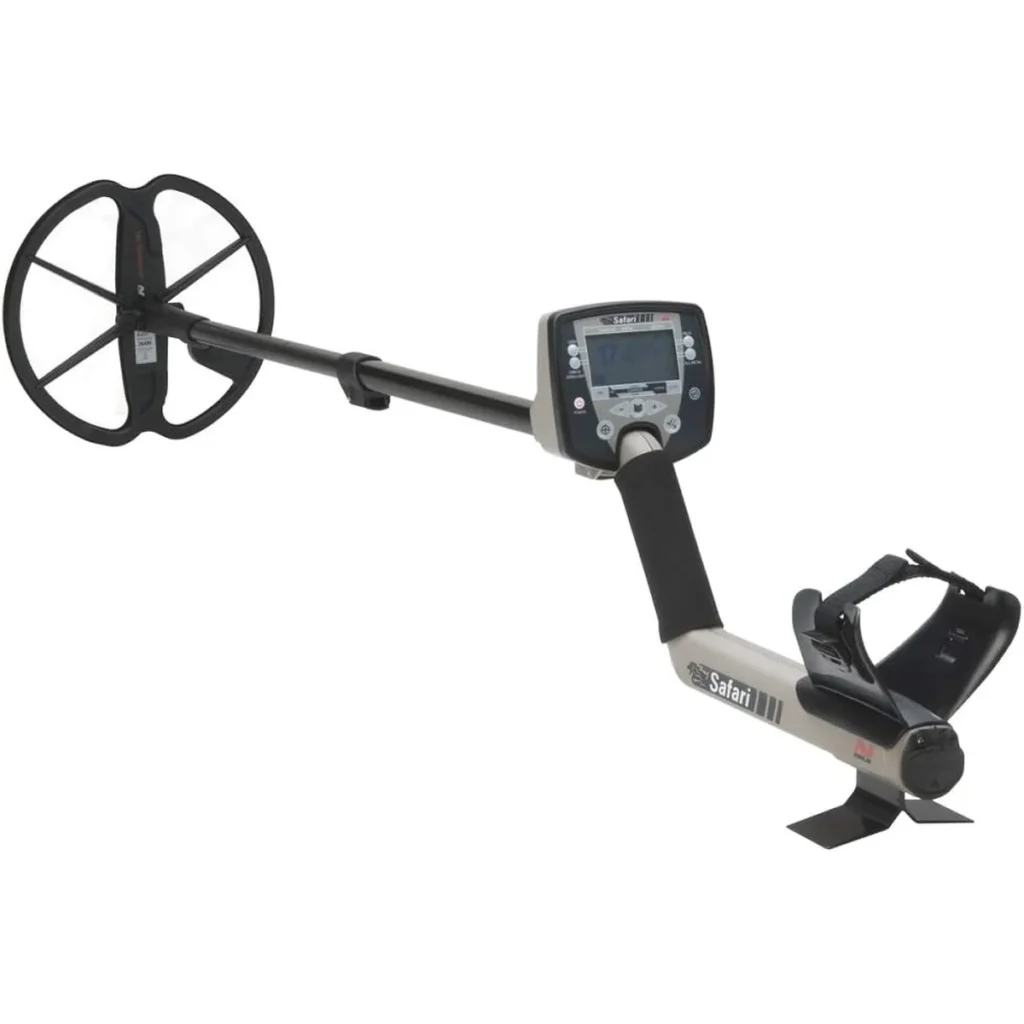
The Safari is one of those machines that never quite got the credit it deserved, and owners will tell you that themselves. It runs Minelab’s FBS, or Full Band Spectrum, multi-frequency system, the same core technology as the old Explorer and the much-loved E-Trac. The difference is that Minelab took that deep engine and wrapped it in a far simpler machine. Where the E-Trac buries you in menus and its own Ferrous/Conductive smartscreen, the Safari uses a normal low-to-high conductivity scale and a lot less setup. Owners often describe it, fairly, as a professional detector that a beginner can actually get on with.
What owners genuinely rave about
The recurring theme across long-term reviews is depth and stability. FBS transmits multiple frequencies at once, and in real terms that means the Safari reads mineralised UK ground well and gives you believable, rock-steady target IDs on high conductors. That matters because a stable ID on a silver coin at depth is what gives you the confidence to dig a marginal deep signal instead of walking off it. One owner recounted pulling a Victorian silver threepence from around ten to twelve inches within hours of buying theirs, then adding a pile of hammered and Roman coins from a field that had already been worked by other machines. That is FBS depth doing what it does best.
The other quiet win is coils. Because the Safari shares its coil mount with the Explorer and E-Trac, there is a healthy second-hand coil market, so fitting a bigger coil for depth or a small one for trashy ground is easy and cheap.
Feed it rechargeables
The single most repeated Safari tip: it runs on eight AA cells and drinks them. Buy good rechargeable AAs from day one, or the running cost will nag at you every session.
The gripes that come up again and again
Two complaints dominate the threads. First, the balance. The Safari is nose-heavy, and over a long hunt owners generally report it becomes tiring on the wrist and arm. Second, and this is the big one, it drinks batteries, as above. Beyond those, it is the slowest of the three FBS machines for recovery speed. Recovery speed is simply how quickly a detector resets between two targets, and a slow machine smears two close signals into one. On clean pasture that barely matters, but drop the Safari onto an iron-carpeted site and it will struggle to pick a good target out from beside the rubbish. And like most of its era, the control box is not waterproof, so this is a dry-land and shallow-edge machine only.
If I were buying one, and who it suits
These only exist used now, and that is where the value is. If I were checking one over, I would open the battery compartment and look hard at the contacts for corrosion, since battery-hungry machines tend to get worked hard there. I would confirm the screen is clean and clear, and swing it over a few known targets to check the IDs settle rather than jump about.
Who is it for? A patient coin and relic hunter working UK pasture or plough who wants proper FBS depth without the E-Trac’s learning curve. Who would I steer away? Anyone who needs to detect in water, anyone hunting dense iron who needs fast recovery, and anyone who wants a light machine for all-day comfort. If you want the same FBS depth with more control and better iron handling, the community consensus is to stretch to a used E-Trac instead, which adds the Iron Mask feature the Safari lacks.
Community Verdict
The settled view is that the Safari is an underrated, seriously deep detector that has aged into a genuine used bargain. Owners who lean into its strengths, stable high-conductor IDs and depth on mineralised ground, still rate it as a proper coin hunter. But nobody pretends it is modern: it is heavy, it is thirsty for batteries, and a current lightweight multi-frequency machine will do most of the same job with far less effort. Buy one cheap, feed it rechargeables, use it on the right ground, and long-term owners reckon it still earns its keep. Pay too much or ask it to fight trash and you will wonder what the fuss was about.
If you have swung a Safari for years and see it differently, I would genuinely like to hear it. Drop me a line through the contact page and I will fold it in.
Full Specifications
How It Performs On Each Terrain
Pros & Cons
👍 What We Like
- ✓FBS multifrequency technology
- ✓Simpler operation than E-TRAC
- ✓Excellent depth for coin shooting
- ✓Good UK beach performance
👎 Watch Out For
- ✗Discontinued – used market only
- ✗No wireless audio option
- ✗Heavier than modern alternatives
- ✗Fewer settings than E-TRAC
A capable, well-rounded choice that delivers solid value. Best suited to intermediate-level detectorists focused on coins, all-purpose.
Last reviewed: 2026-05-24
Affiliate disclosure: we may earn a commission at no extra cost to you. Our reviews stay independent.
Minelab Safari: Owner's Reference and Setup
The practical detail behind the review: the coils that fit, sensible starting settings and the questions owners ask most. This is a discontinued FBS machine, the simpler sibling of the E-TRAC, so the reference reflects that. Checked against Minelab's legacy listings and the wider owner community.
Best accessories for the Minelab Safari
- A bungee harness or chest support The Safari is a heavier FBS machine, so weight relief transforms an all-day hunt.
- Wired or Koss headphones Faint deep FBS targets reward good audio.
- FBS coils Cheap protection for the standard 11 inch coil.
- A coil cover Cheap protection for the standard 11 inch coil.
Coils that fit the Minelab Safari
| Coil | Type | Best for |
|---|---|---|
| 11 in FBS Pro | DD | General all-round use and the standard coil |
| 8 in FBS | DD | Trashy iron-littered ground and tight separation |
| 15 in aftermarket | DD | Extra coverage on cleaner ground |
The Safari uses Minelab's FBS coil family, shared with the E-TRAC, Explorer and Quattro. FBS coils are waterproof to 1 metre. Aftermarket makers like CORS also make FBS coils; confirm the fit before buying.
Headphones and audio for the Minelab Safari
The Safari uses wired headphones. Its deep FBS targets reward good audio.
Best settings for the Minelab Safari
- The Safari uses FBS (Full Band Spectrum) multi-frequency, transmitting 28 frequencies at once, so lean on the automatic processing rather than fiddling.
- Use the preset modes and let the FBS engine do the work; it is simpler than the E-TRAC by design.
- Ground balance is largely automatic on FBS; focus on discrimination patterns.
- Sweep slowly, since FBS depth rewards a steady, deliberate swing.
Firmware and manuals for the Minelab Safari
There is no user-installable firmware for the Safari. Treat the installed control box as final.
Minelab host legacy FBS manuals in their downloads archive; use them for the modes and discrimination setup.
View the manualMinelab Safari: common questions
Is the Safari waterproof?
The coil is waterproof to 1 metre; the control box is not submersible. It is a discontinued machine, so check condition when buying used.
How is the Safari different from the E-TRAC?
Both are FBS multi-frequency machines. The Safari is the simpler, more automated one; the E-TRAC adds the two-dimensional Smartfind display and deeper customisation.
Is the Safari still worth buying?
For deep FBS coin and relic work on a budget, a good used one can be, but weigh it against a lighter modern multi-frequency machine.
More detectors and guides
Browse other Minelab machines like Minelab X-Terra Pro, Minelab Manticore and Minelab GPX 6000. Read the Minelab range in full, or open the detecting glossary for plain-English explanations of target ID, iron bias and ground balance.