Minelab E-TRAC Review
Review Overview
Let me be straight with you before we start
I have never owned a Minelab E-TRAC. It has never been on my arm in a field, and I am not going to pretend otherwise. My own machines have been Garretts, a Minelab X-Terra 705 and the Nokta Simplex I still swear by.
The E-TRAC, though, is one of those detectors with a genuine mountain of long-term experience behind it. So what follows is my honest attempt to boil down years of forum threads, long-term owner write-ups and manuals, specifications and owner reports into where the community has really landed on it.
The machine that earned a reputation for finding silver everyone else missed
To understand why detectorists still talk about a machine launched back in 2008, you have to understand what it was built to do. The E-TRAC was Minelab’s flagship coin and relic machine, the top of the Explorer bloodline, and it ran their FBS technology, Full Band Spectrum. In plain terms that is simultaneous multi-frequency across a very wide range, and it gave the E-TRAC a reputation that has never really faded: it is a deep-silver machine. Owners talk about it the same way over and over. It sings on silver. People report it pulling silver coins out of ground where other detectors barely raised a whisper, and for a certain kind of coin hunter that is the whole game.
Over here it earned its stripes on old pasture, on the deep hammered and Roman coins that sit just past the reach of lesser machines. It became one of those detectors that serious permission hunters swore by, and a lot of very good finds came out of the ground under an E-TRAC coil.
Smartfind: the feature owners rave about, and why it matters
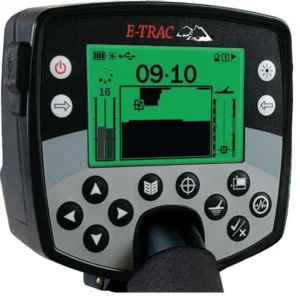
If there is one thing that made the E-TRAC special beyond raw depth, it is Smartfind, Minelab’s two-dimensional discrimination. This is worth explaining properly, because it is the bit that keeps the machine relevant.
Most detectors give you a single target ID number on a one-dimensional scale, low for iron, high for silver. Smartfind plots the target in two dimensions instead: how conductive it is AND how ferrous it is, shown as a position on a grid rather than a single number. Why does that matter in the dirt? Because a single number throws away half the story. A bottle cap and a silver coin can read at similar conductivity, but their ferrous character is different, and the E-TRAC shows you that difference. Long-term owners say that two-dimensional read is what lets them tell trash from treasure with real confidence, and even separate silver from clad, on ground where a one-number machine leaves you guessing. It is more information about what is under the coil than most detectors of its generation could give you, and that is precisely why so many owners fell for it.
The audio takes time, and the community is honest about that
Here is where I would set your expectations. The E-TRAC is not a switch-on-and-go machine, and nobody who has run one will tell you it is. The audio is tonal and layered, and by broad agreement it can sound genuinely alien when you first pick the machine up, especially if you have come off something simpler. The consensus is blunt: it has a long learning curve, and for a beginner it can be a real slog until the tones start to mean something instinctively. The flip side, and owners say this just as often, is that once it clicks, once you stop reading the screen and start reading the ground by ear, the machine becomes a joy and you understand why people are so loyal to it. But that is months of regular use, not a weekend. Go in expecting to grow into it.
The gripes that come up again and again
A review is only worth reading if it tells you the bad with the good, and the E-TRAC has some well-documented weak spots that matter more now than they did in 2008.
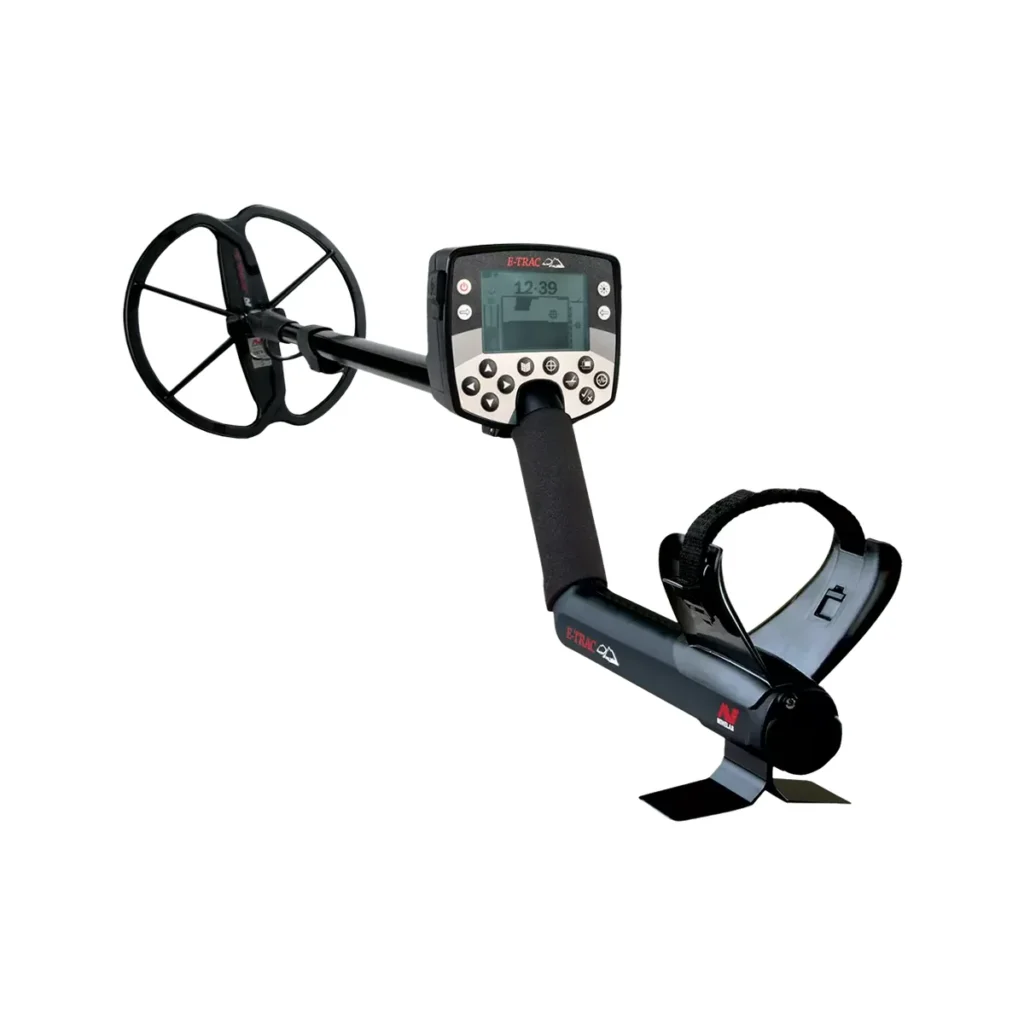
The first is weight and balance. It is a heavy machine, and more to the point it is nose-heavy, so the load sits out at the end of your arm rather than nicely balanced. Owners consistently describe it as tiring over a long day, and the moment you fit one of the big aftermarket coils for extra depth, you are genuinely into harness territory to save your arm. That is not a detail, it is the difference between detecting all day and packing up early.
The second, and personally this is the one I would weigh most carefully, is recovery speed. The E-TRAC’s recovery speed is slow by modern standards. Recovery speed is how quickly the machine resets after one target before it can cleanly hear the next, and when it is slow, two targets sitting close together smear into a single signal. On a clean pasture chasing deep silver that barely matters. But on an iron-carpeted site, the sort of hammered permission that is wall-to-wall nails, a slow machine will blend the good target into the junk beside it and you walk over it. This is exactly the ground where a modern fast machine pulls ahead, and it is the single biggest reason the E-TRAC has dated.
The third is water, or the lack of it. The control box is not waterproof. This is a dry-land machine, and if beach and water work is on your list, this was never the tool, which is a large part of why Minelab waterproofed the platform in the machine that followed it.
Buying one used in 2026? Check these before you hand over cash
- It powers up and holds a stable target ID indoors rather than jumping around.
- Work through the menus so you know nothing has gone wrong in the software.
- The lower shaft is a known wear item, so check it is not cracked or sloppy. Replacements are common and cheap.
- Look over the coil ear and connector for cracks, and check the screen.
- Check the battery pod. A tired rechargeable pack is worth factoring into the price.
Where it sits now, and whether to spend up
The honest question in 2026 is whether the E-TRAC still makes sense when you could buy something newer. Its direct successor was the CTX 3030 in 2012, and that is the natural step up: same FBS DNA and the same superb Smartfind ID, but fully waterproof, with GPS mapping added, and by most accounts a touch deeper and more stable in its target ID. If you love the FBS way of working and want it done properly, the CTX is the machine, though it costs a lot more used.
Then there is the modern crowd. The Equinox 800 and 900, the XP Deus 2, the Nokta Legend and Minelab’s own Manticore are all lighter, faster in recovery and run the newer Multi-IQ engine. For all-round detecting and especially for trashy ground, those machines have moved the game on, and Minelab themselves retired the FBS platform in favour of Multi-IQ, which tells you where they think the future is. What the E-TRAC still has over most of them is that deep-silver reputation and the Smartfind read, which is why a stubborn core of coin hunters have never given theirs up.
Community Verdict
After ploughing through years of owner opinion, the verdict is consistent and fair-minded. The E-TRAC is a genuine classic and still a deep-silver specialist, a machine that will find coins other detectors miss and reward a patient owner who learns its tones. But for a modern buyer it is held back by real things: the weight and nose-heavy balance, the slow recovery speed that struggles on iron-heavy ground, the long learning curve and the lack of waterproofing.
It is far better bought used than new, and it has been overshadowed, on paper at least, by the CTX 3030 that refined it and by the lighter, faster multi-frequency machines that followed. Yet ask its die-hards if they would swap it for deep coin work and plenty still say no. Bought cheap by someone who knows exactly what they want it for, it is a huge amount of finding power. Bought by a beginner expecting an easy life, it will end up on the forums for sale within the month.
This is me handing on the collected wisdom of people who have actually put the years in with an E-TRAC, not my own field notes. If you have run one yourself and reckon I have got any of this wrong, drop me a line through the contact page. The site is always better for being corrected.
Full Specifications
Pros & Cons
👍 What We Like
- ✓Legendary depth on hammered silver
- ✓2D SmartFind discrimination screen
- ✓Highly accurate target ID in iron
- ✓Huge user community and knowledge base
👎 Watch Out For
- ✗Now discontinued (no warranty support)
- ✗Heavy at 5.3 lbs
- ✗Learning curve for SmartFind screen
- ✗Bulky compared to modern detectors
How It Performs
An excellent all-round detector that punches well above its price. Best suited to advanced-level detectorists focused on coins, relics.
Last reviewed: 2026-05-24
Affiliate disclosure: we may earn a commission at no extra cost to you. Reviews stay independent.
Minelab E-TRAC: Owner's Reference and Setup
The practical detail behind the review: the coils that fit, sensible starting settings and the questions owners ask most. This is a discontinued FBS machine and a direct ancestor of the CTX 3030, so the reference reflects that. Checked against Minelab's legacy listings and the wider owner community.
Best accessories for the Minelab E-TRAC
- A bungee harness or chest support The E-TRAC is a heavier FBS machine, so weight relief transforms an all-day hunt.
- Wired or Koss headphones Faint deep FBS targets reward good audio.
- FBS coils Cheap protection for the standard 11 inch coil.
- A coil cover Cheap protection for the standard 11 inch coil.
Coils that fit the Minelab E-TRAC
| Coil | Type | Best for |
|---|---|---|
| 11 in FBS Pro | DD | General all-round use and the standard coil |
| 8 in FBS | DD | Trashy iron-littered ground and tight separation |
| 15 in aftermarket | DD | Extra coverage on cleaner ground |
The E-TRAC uses Minelab's FBS coil family, shared with the Safari, Explorer and Quattro. FBS coils are waterproof to 1 metre. Aftermarket makers like CORS also make FBS coils; confirm the fit before buying.
Headphones and audio for the Minelab E-TRAC
The E-TRAC uses wired headphones. Its deep FBS targets reward good audio.
Best settings for the Minelab E-TRAC
- The E-TRAC uses FBS (Full Band Spectrum) multi-frequency with the two-dimensional Smartfind display, so learn to read targets on the Fe-Co screen.
- Build and save discrimination patterns for your sites rather than relying on audio alone.
- Ground balance is largely automatic on FBS; focus on the Smartfind display and pattern editing.
- Sweep slowly and deliberately, since FBS depth rewards patience.
Firmware and manuals for the Minelab E-TRAC
The E-TRAC is updateable via Minelab's XChange 2 software over USB. Minelab do not fix a current version here, so check their legacy software archive.
Minelab host legacy E-TRAC manuals and the XChange 2 software in their downloads archive; the manual rewards a read given the depth of the Smartfind system.
View the manualMinelab E-TRAC: common questions
Is the E-TRAC waterproof?
The coil is waterproof to 1 metre; the control box is not submersible. It is a discontinued machine, so check condition when buying used.
How is the E-TRAC different from the CTX 3030?
The E-TRAC is the FBS ancestor of the CTX. The CTX adds GPS mapping, wireless audio and full submersibility, but the E-TRAC's core FBS discrimination is very capable.
Is the E-TRAC good for beginners?
Not really. Its Smartfind system rewards study, so it suits a committed detectorist rather than a first-timer.
More detectors and guides
Browse other Minelab machines like Minelab X-Terra Pro, Minelab Manticore and Minelab GPX 6000. Read the Minelab range in full, or open the detecting glossary for plain-English explanations of ground balance, notch discrimination and depth.